
What Is AWG Wire Gauge? How Do You Choose the Right Wire Size?
AWG (American Wire Gauge) is a standardized system used to indicate the size of electrical wires. The smaller the AWG number, the thicker the wire and the higher the current it can carry. Conversely, the larger the AWG number, the thinner the wire, making it more suitable for low-current or signal transmission applications.
Choosing the wrong AWG size may result in excessive voltage drop, increased heat generation, and reduced system reliability. That's why AWG is one of the most important specifications when designing wire harnesses, cable assemblies, and electronic products.
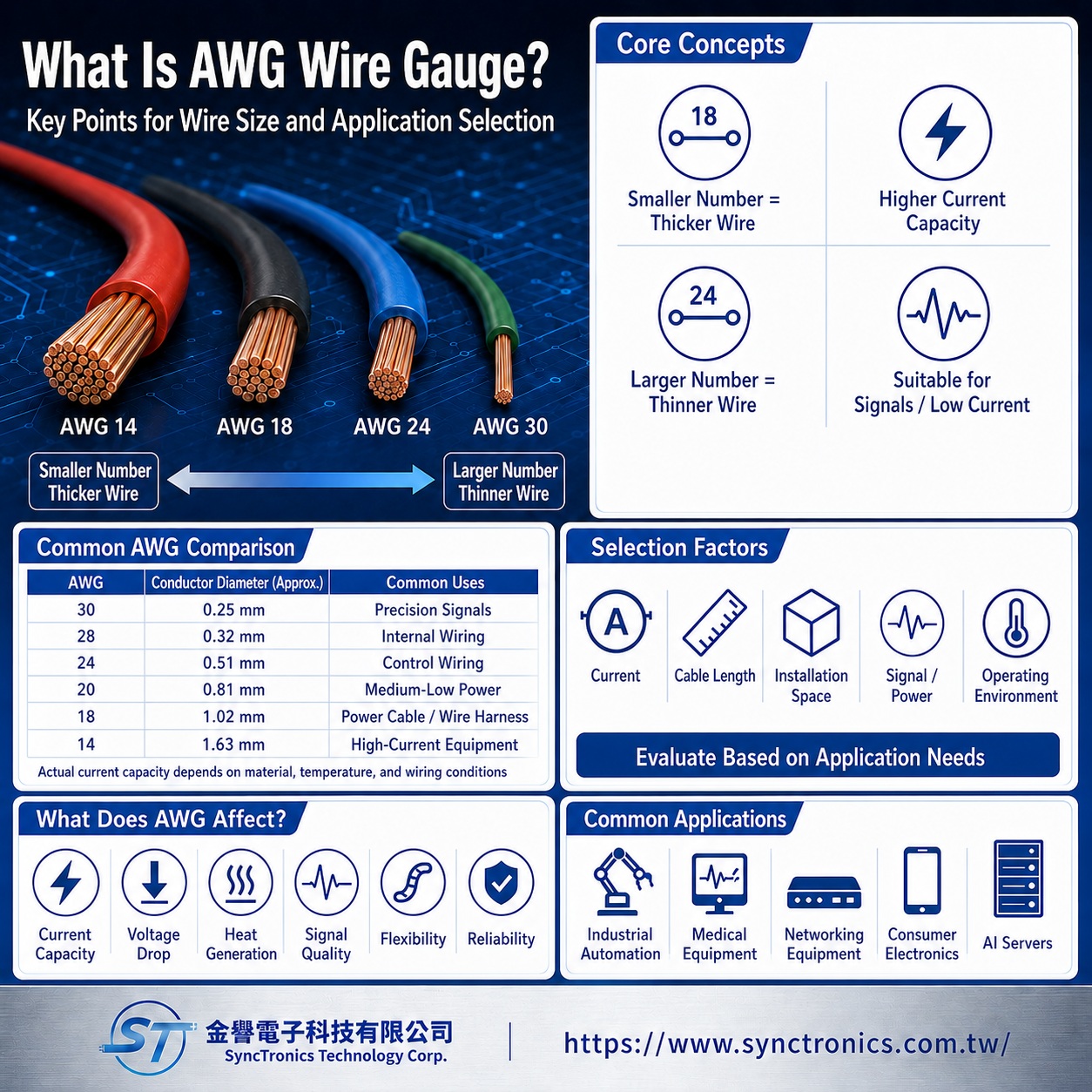
What Is AWG Wire Gauge?
AWG stands for American Wire Gauge, a standardized wire sizing system widely used to specify the diameter of electrical conductors.
Unlike many numbering systems, a lower AWG number indicates a larger wire diameter, while a higher AWG number indicates a smaller wire diameter. For example, AWG 18 is thicker than AWG 24, making it suitable for higher current applications. Smaller sizes such as AWG 28 are commonly used for signal transmission, compact electronics, and internal wiring.
Today, AWG is widely adopted across industries, including industrial automation, medical equipment, networking devices, automotive electronics, consumer electronics, and custom cable assembly manufacturing.
Common AWG Sizes
|
AWG |
Approx. Diameter (mm) |
Typical Applications |
|
30 |
0.25 |
Precision electronics, signal wiring |
|
28 |
0.32 |
Internal wiring, low-current devices |
|
26 |
0.40 |
Sensors, control signals |
|
24 |
0.51 |
General electronic equipment |
|
22 |
0.64 |
Industrial control wiring |
|
20 |
0.81 |
Medium-power applications |
|
18 |
1.02 |
Power wiring, cable assemblies |
|
16 |
1.29 |
Higher current equipment |
|
14 |
1.63 |
Industrial power applications |
Actual current-carrying capacity depends on conductor material, insulation type, ambient temperature, installation method, and applicable safety standards.
How Do You Choose the Right AWG?
Selecting the appropriate AWG wire size typically involves evaluating several factors:
|
Consideration |
Description |
|
Current Capacity |
Higher current generally requires a larger wire size. |
|
Cable Length |
Longer cable runs increase voltage drop and may require thicker conductors. |
|
Installation Space |
Compact designs may require balancing wire size with available space. |
|
Signal vs. Power |
Signal cables and power cables often require different wire gauges. |
|
Operating Environment |
Temperature, vibration, and environmental conditions affect wire selection. |
There is no universal "best" AWG. The appropriate wire size should always match the specific application requirements.
Why Does AWG Matter?
Selecting the proper AWG directly affects the overall performance of an electrical system, including:
- Current carrying capacity
- Voltage drop
- Heat generation
- Signal integrity
- Cable flexibility
- Long-term reliability
For this reason, AWG selection is typically considered together with conductor material, insulation type, connectors, and cable assembly design.
Solution for Your Applications
SyncTronics provides professional wire harness manufacturing, custom cable assembly, and electronic wiring solutions tailored to your application requirements. We assist customers in selecting the appropriate AWG wire size, connectors, terminals, and assembly methods for industrial automation, medical equipment, networking devices, AI servers, consumer electronics, and many other industries.
Conclusion
AWG is one of the most fundamental specifications in electrical wiring and cable assembly design. Selecting the correct wire gauge helps improve power delivery, signal quality, thermal performance, and overall product reliability.
By combining the right AWG wire size with quality materials, connectors, and manufacturing processes, engineers can build safer, more reliable, and longer-lasting electronic products.
Need Wire Harnesses, Connectors, Electromechanical Components, or Custom Solutions? Contact Us Today
Whether you are looking for connectors,
cables, wire harness assemblies, electromechanical components, or complete
electronic interconnect solutions, SyncTronics provides professional technical
support and engineering evaluation for product selection, specification
verification, New Product Introduction (NPI), OEM/ODM customization, as well as
high-speed transmission, high-reliability, and other specialized application
requirements.
We welcome you to visit our Contact Us page and
share your project requirements and contact information. Our team is committed
to responding quickly and professionally, evaluating the most suitable
products and electronic interconnect solutions based on your product
specifications, application requirements, and project objectives. We also
provide technical recommendations and customized engineering support to help
shorten product selection and development time, reduce project risks, and
accelerate your path to mass production. We look forward to the opportunity to
work with you and provide reliable technical support and practical solutions
for every stage of your project.
Related Articles:
What Are UL-Rated Wires? UL Wire Certification & Standards Explained | SyncTronics Technology
What Is Cable Assembly? Complete Guide | SyncTronics Technology
Cable Processing Workflow Explained | SyncTronics Technology
Wire Cutting, Stripping, Crimping & Assembly Guide | SyncTronics Technology
Disclaimer and Technical Exchange Statement
This content is compiled based on publicly
available information and industry experience, intended solely for reference
during technical exchanges. It does not constitute any commercial, technical,
or legal advice or basis.
The specifications, materials, manufacturing processes, application methods,
and related information described herein may vary due to differing design
conditions, environmental factors, or usage scenarios. No guarantees are made
regarding the completeness, correctness, or suitability of such content.
Readers should verify the suitability with the responsible design or technical
personnel based on actual application scenarios, and independently assess all
associated risks.
Frequently Asked Questions (FAQ)
- What is Connector Knowledge
- Wire Related issues
- What Is Wire Harness Assembly? Complete Guide to the Process, Applications, and Benefits
- 60W vs. 100W vs. 140W vs. 240W USB-C Cables: What's the Difference?
- Are All USB-C Cables the Same?
- Solar vs. Energy Storage Cables: Weather Resistance, Voltage & Selection Guide
- What Is a BMS Wire Harness? Cell Voltage, Temperature Sensing & Balancing Explained
- How to Select Energy Storage Power Wire Harnesses: Current, Voltage, Temperature Rise & Flame Retardancy
- What Is Silicone Wire? High-Temperature Properties, Structure & Selection
- How to Choose AWG Wire Size for Drone Power Cables
- How to Select Drone Wires: Lightweight Design, Flexibility, Heat Resistance and Waterproofing
- What Is a High-Speed Transmission Cable?
- What Is a Twisted Pair Cable? Why Does It Reduce Electromagnetic Interference?
- Industrial Cable Applications Explained: How to Select High Temperature, Waterproof, and High Reliability Cables
- What Are the Steps in Wire Processing? Complete Guide to the Manufacturing Process
- What Are Wire Cutting, Wire Stripping, Crimping, and Assembly?
- What Is a High Temperature Cable?
- What Is an Oil-Resistant and Abrasion-Resistant Cable?
- What Is a Waterproof Cable?
- What Are UL-Rated Wires?
- What Is AWG Wire Gauge? How Do You Choose the Right Wire Size?
- What Is a Controlled Impedance Cable?
- What Is a Differential Signal Cable?
- What Is a High Frequency Cable?
- What Is the Difference Between a Coaxial Cable and a Ribbon Cable?
- Older Network Cable Versions Explained: What Are CAT3, CAT4, and CAT5?
- CAT5e vs CAT6 vs CAT6a vs CAT7 vs CAT8 Complete Guide
- STP vs UTP Ethernet Cables: Understanding Shielded and Unshielded Twisted Pair Differences
- What Are the Differences Between USB, HDMI, D-Sub, and LVDS Cables?
- Materials-Related
- Regulatory Issues
- Electronic issues
- Manufacturing Technology
- Testing & Verification
- Quality Management
- History & Evolution