
What Is PPAP? A Complete Guide to the Production Part Approval Process
What Is PPAP? A Complete Guide to the Production Part Approval Process
PPAP (Production Part Approval Process) is one of the most important quality management methodologies in the automotive industry. Developed by the Automotive Industry Action Group (AIAG), PPAP is designed to ensure that suppliers consistently manufacture products that meet customer engineering specifications and quality requirements before mass production begins.
Although PPAP originated in the automotive sector, it is now widely adopted by manufacturers of connectors, wire harnesses, electronic components, precision metal parts, and industrial equipment, especially when serving international customers.
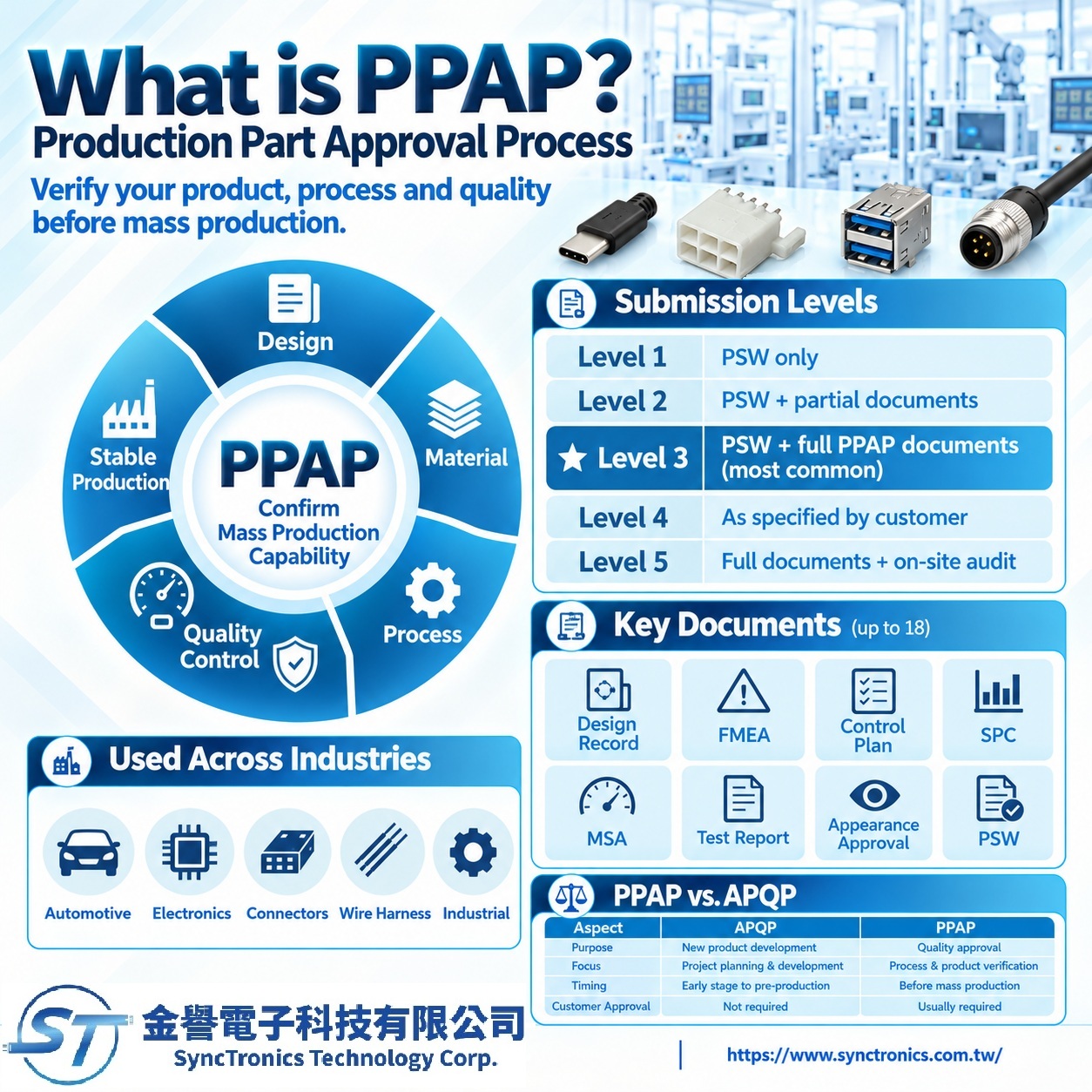
What Is PPAP?
PPAP, or Production Part Approval Process, is a standardized approval procedure used to demonstrate that both a product and its manufacturing process are capable of consistently producing parts that satisfy customer requirements.
Rather than inspecting only a single finished product, PPAP evaluates the entire production process, including materials, equipment, documentation, process controls, and quality systems.
Its primary objective is to verify manufacturing capability and production consistency before full-scale production.
Why Is PPAP Important?
PPAP helps customers verify that:
- Product designs meet engineering specifications.
- Raw materials comply with required standards.
- Manufacturing processes have been validated.
- Quality control procedures are properly established.
- Production processes are stable and repeatable.
- Potential quality risks are minimized before mass production.
For this reason, PPAP is commonly required whenever new products, design revisions, material changes, or manufacturing process modifications occur.
When Is PPAP Required?
Typical situations include:
- New product development
- New tooling implementation
- Material changes
- Manufacturing process changes
- Production site relocation
- Customer-requested revalidation
- Production restart after an extended shutdown
PPAP Submission Levels
According to AIAG guidelines, PPAP consists of five submission levels.
|
Level |
Description |
|
Level 1 |
Part Submission Warrant (PSW) only |
|
Level 2 |
PSW with limited supporting documentation |
|
Level 3 |
PSW with complete PPAP documentation (most commonly used) |
|
Level 4 |
Documentation specified by the customer |
|
Level 5 |
Complete documentation plus on-site review |
Level 3 is the submission level most frequently required throughout the automotive and electronics industries.
Common PPAP Documentation
A complete PPAP package may include up to 18 elements, including:
- Design Records
- Engineering Change Documents
- Design Failure Mode and Effects Analysis (DFMEA)
- Process Failure Mode and Effects Analysis (PFMEA)
- Process Flow Diagram
- Control Plan
- Measurement System Analysis (MSA)
- Statistical Process Control (SPC)
- Dimensional Inspection Results
- Material Test Reports
- Performance Test Results
- Initial Process Capability Studies (Cp/Cpk)
- Appearance Approval Report (when applicable)
- Sample Production Parts
- Master Sample
- Checking Aids Documentation
- Customer-Specific Requirements
- Part Submission Warrant (PSW)
The exact documentation required depends on the customer's specifications and the selected PPAP submission level.
PPAP vs. APQP
Although closely related, PPAP and APQP serve different purposes.
|
Item |
APQP |
PPAP |
|
Purpose |
Product development planning |
Production approval |
|
Focus |
Project management and development |
Product and process validation |
|
Timing |
Throughout product development |
Immediately before mass production |
|
Customer Approval |
Not always required |
Usually required |
In simple terms, APQP manages the development process, while PPAP confirms production readiness.
PPAP vs. FAI (First Article Inspection)
|
Item |
PPAP |
FAI |
|
Evaluation Target |
Manufacturing process capability |
First production part |
|
Typical Industries |
Automotive, electronics, industrial manufacturing |
Aerospace, defense, precision manufacturing |
|
Evaluation Scope |
Documentation, process capability, quality system |
Dimensions, appearance, product conformity |
|
Objective |
Verify production readiness |
Verify first article compliance |
Industries That Commonly Use PPAP
PPAP is widely implemented in:
- Automotive components
- Wire harness manufacturing
- Connector manufacturing
- Precision stamping
- Precision metal components
- Electronic components
- Industrial equipment
- Automation systems
- Electric vehicle supply chains
Frequently Asked Questions
Is PPAP only required in the automotive industry?
No. While PPAP originated in the automotive sector, many electronics manufacturers, industrial equipment suppliers, and global OEMs also require PPAP documentation from their suppliers.
Is PPAP simply a product inspection?
No. PPAP evaluates the entire manufacturing process and quality management system, not just an individual product.
What is the difference between PPAP and ISO 9001?
ISO 9001 is an international quality management system standard, whereas PPAP is a product approval process used before mass production. The two complement each other but serve different purposes.
Does PPAP need to be resubmitted?
Yes. PPAP typically must be resubmitted whenever significant changes occur, including product design revisions, material substitutions, manufacturing process changes, equipment replacement, factory relocation, or customer requirements.
Conclusion
PPAP is a critical quality management methodology used to verify that suppliers can consistently manufacture products that meet customer specifications before mass production begins. Through comprehensive documentation, process validation, and quality system verification, PPAP reduces production risks, improves customer confidence, and strengthens supply chain reliability.
For manufacturers of connectors, wire harnesses, electronic components, precision metal parts, and industrial products, PPAP has become an essential requirement for serving global customers and participating in international supply chains.
Need Wire Harnesses, Connectors, Electromechanical Components, or Custom Solutions? Contact Us Today
Whether you are looking for connectors,
cables, wire harness assemblies, electromechanical components, or complete
electronic interconnect solutions, SyncTronics provides professional technical
support and engineering evaluation for product selection, specification
verification, New Product Introduction (NPI), OEM/ODM customization, as well as
high-speed transmission, high-reliability, and other specialized application
requirements.
We welcome you to visit our Contact Us page
and share your project requirements and contact information. Our team is
committed to responding quickly and professionally, evaluating the most
suitable products and electronic interconnect solutions based on your product
specifications, application requirements, and project objectives. We also
provide technical recommendations and customized engineering support to help
shorten product selection and development time, reduce project risks, and
accelerate your path to mass production. We look forward to the opportunity to
work with you and provide reliable technical support and practical solutions
for every stage of your project.
Related Articles:
Disclaimer and Technical Exchange Statement
This content is compiled based on publicly available information and industry experience, intended solely for reference during technical exchanges. It does not constitute any commercial, technical, or legal advice or basis.
The specifications, materials, manufacturing processes, application methods, and related information described herein may vary due to differing design conditions, environmental factors, or usage scenarios. No guarantees are made regarding the completeness, correctness, or suitability of such content.
Readers should verify the suitability with the responsible design or technical personnel based on actual application scenarios, and independently assess all associated risks.
Frequently Asked Questions (FAQ)
- What is Connector Knowledge
- Wire Related issues
- Materials-Related
- Regulatory Issues
- Electronic issues
- Manufacturing Technology
- Testing & Verification
- Quality Management
- MOQ vs. MPQ vs. SPQ
- What Is NCNR?
- What Is an LOA (Letter of Authorization)?
- ECR vs. ECN: How the Engineering Change Process Works
- How Is Material Traceability Managed for Energy Storage Wire Harnesses? Lot, Wire & Terminal Control
- What Is PPAP? A Complete Guide to the Production Part Approval Process
- What Are EOL and PCN?
- What Is Incoming Quality Control (IQC)?
- What Is In-Process Quality Control (IPQC)?
- What Is Outgoing Quality Control (OQC)?
- What Is AQL (Acceptable Quality Level)?
- What Are CoC and CoA?
- What Is Material Traceability?
- What Is a Date Code (D/C)?
- What Are LOT Numbers and BIN Codes?
- What Is FMEA (Failure Mode and Effects Analysis)?
- What Is an 8D Report?
- What Is Six Sigma?
- What Are Cp and Cpk?
- What Is a Control Plan?
- What Is ISO 9001?
- What Is IATF 16949?
- History & Evolution