
What Are the Steps in Wire Processing? Complete Guide to the Manufacturing Process
Wire processing is the manufacturing process of preparing electrical wires for use in electronic products and equipment. It typically includes wire cutting, stripping, terminal crimping, connector assembly, protection, and quality testing to ensure reliable power and signal transmission. High-quality wire processing plays a critical role in the performance, reliability, and service life of electronic systems.
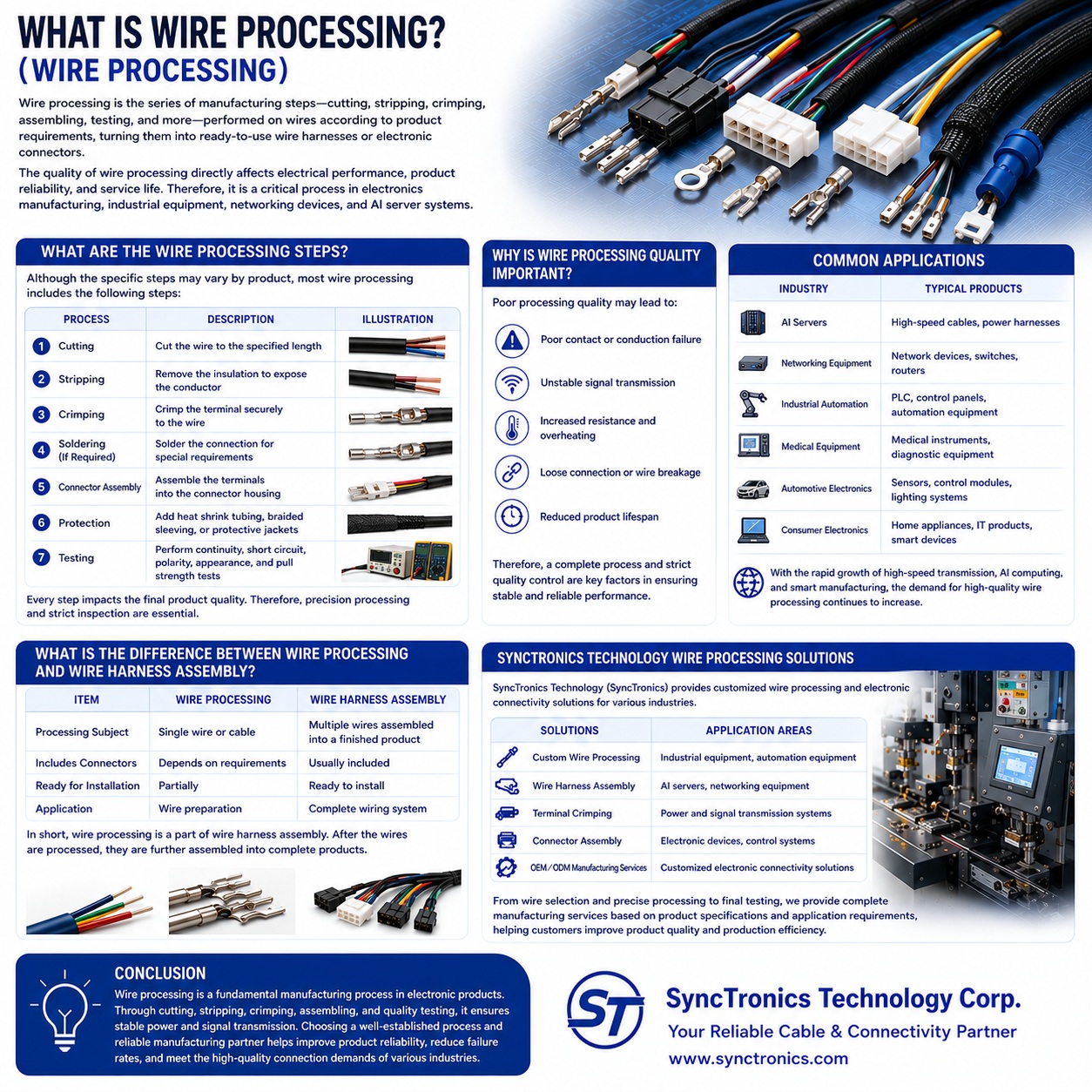
What Are the Main Steps in Wire Processing?
Although processing methods vary depending on the product, most wire processing follows these standard procedures:
|
Process |
Description |
|
Wire Cutting |
Cutting wires to the required length according to specifications |
|
Wire Stripping |
Removing insulation to expose the conductor |
|
Terminal Crimping |
Securely attaching terminals to the wire conductor |
|
Soldering (Optional) |
Used when additional electrical or mechanical strength is required |
|
Connector Assembly |
Installing terminals into connector housings |
|
Protective Processing |
Applying heat-shrink tubing, braided sleeves, or protective coverings |
|
Quality Inspection |
Continuity, short-circuit, polarity, pull-force, and visual inspection |
Each manufacturing step contributes directly to the final product's quality, reliability, and long-term performance.
Why Is Wire Processing Important?
Poor wire processing may lead to:
- Unstable electrical connections
- Signal transmission issues
- Increased electrical resistance and heat generation
- Loose terminals or broken wires
- Reduced product lifespan
For this reason, precision manufacturing and comprehensive quality inspection are essential in electronic production.
Common Applications of Wire Processing
|
Industry |
Typical Applications |
|
AI Servers |
High-speed cable assemblies, power harnesses |
|
Networking Equipment |
Switches, routers, communication systems |
|
Industrial Automation |
PLCs, control cabinets, automation equipment |
|
Medical Devices |
Diagnostic instruments, medical equipment |
|
Automotive Electronics |
Sensors, control modules, lighting systems |
|
Consumer Electronics |
Home appliances, computers, smart devices |
As AI computing, high-speed communication, and smart manufacturing continue to grow, demand for precision wire processing continues to increase.
What Is the Difference Between Wire Processing and Wire Harness Assembly?
|
Comparison |
Wire Processing |
Wire Harness Assembly |
|
Processing Scope |
Individual wires or cables |
Complete wiring systems |
|
Includes Connectors |
Depending on requirements |
Usually included |
|
Ready for Installation |
Sometimes |
Yes |
|
Primary Purpose |
Preparing wires |
Delivering a complete cable assembly |
In simple terms, wire processing is one of the key manufacturing stages within the complete wire harness assembly process.
SyncTronics Wire Processing Solutions
SyncTronics provides customized wire processing and electronic interconnect solutions for a wide range of industries, supporting customers from prototype development to mass production.
Our services include:
|
Solution |
Applications |
|
Custom Wire Processing |
Industrial equipment and automation systems |
|
Wire Harness Assembly |
AI servers, networking equipment |
|
Terminal Crimping Services |
Power distribution and signal transmission |
|
Connector Assembly |
Electronic devices and control systems |
|
OEM / ODM Manufacturing |
Customized electronic interconnect solutions |
From wire selection and precision processing to final inspection and testing, SyncTronics delivers reliable manufacturing solutions designed to improve product quality and production efficiency.
Summary
Wire processing is one of the fundamental manufacturing processes in the electronics industry. Through precision cutting, stripping, crimping, assembly, and quality inspection, it ensures reliable electrical and signal transmission for a wide range of applications. High-quality wire processing helps improve product reliability, reduce failure rates, and support the growing demands of AI infrastructure, industrial automation, networking equipment, and advanced electronic systems.
Need Wire Harnesses, Connectors, Electromechanical Components, or Custom Solutions? Contact Us Today
Whether you are looking for connectors,
cables, wire harness assemblies, electromechanical components, or complete
electronic interconnect solutions, SyncTronics provides professional technical
support and engineering evaluation for product selection, specification
verification, New Product Introduction (NPI), OEM/ODM customization, as well as
high-speed transmission, high-reliability, and other specialized application
requirements.
We welcome you to visit our Contact Us page and share your project requirements and contact information. Our team is committed to responding quickly and professionally, evaluating the most suitable products and electronic interconnect solutions based on your product specifications, application requirements, and project objectives. We also provide technical recommendations and customized engineering support to help shorten product selection and development time, reduce project risks, and accelerate your path to mass production. We look forward to the opportunity to work with you and provide reliable technical support and practical solutions for every stage of your project.
Related Articles:
What Is a High Temperature Cable? Materials, Features & Applications | SyncTronics Technology
What Is a Waterproof Cable? IP Ratings, Features & Applications | SyncTronics Technology
What Are UL-Rated Wires? UL Wire Certification & Standards Explained | SyncTronics Technology
What Is AWG Wire Gauge? Complete Guide | SyncTronics Technology
Disclaimer and Technical Exchange Statement
This content is compiled based on publicly
available information and industry experience, intended solely for reference
during technical exchanges. It does not constitute any commercial, technical,
or legal advice or basis.
The specifications, materials, manufacturing processes, application methods,
and related information described herein may vary due to differing design
conditions, environmental factors, or usage scenarios. No guarantees are made
regarding the completeness, correctness, or suitability of such content.
Readers should verify the suitability with the responsible design or technical
personnel based on actual application scenarios, and independently assess all
associated risks.
Frequently Asked Questions (FAQ)
- What is Connector Knowledge
- Wire Related issues
- What Is Wire Harness Assembly? Complete Guide to the Process, Applications, and Benefits
- 60W vs. 100W vs. 140W vs. 240W USB-C Cables: What's the Difference?
- Are All USB-C Cables the Same?
- Solar vs. Energy Storage Cables: Weather Resistance, Voltage & Selection Guide
- What Is a BMS Wire Harness? Cell Voltage, Temperature Sensing & Balancing Explained
- How to Select Energy Storage Power Wire Harnesses: Current, Voltage, Temperature Rise & Flame Retardancy
- What Is Silicone Wire? High-Temperature Properties, Structure & Selection
- How to Choose AWG Wire Size for Drone Power Cables
- How to Select Drone Wires: Lightweight Design, Flexibility, Heat Resistance and Waterproofing
- What Is a High-Speed Transmission Cable?
- What Is a Twisted Pair Cable? Why Does It Reduce Electromagnetic Interference?
- Industrial Cable Applications Explained: How to Select High Temperature, Waterproof, and High Reliability Cables
- What Are the Steps in Wire Processing? Complete Guide to the Manufacturing Process
- What Are Wire Cutting, Wire Stripping, Crimping, and Assembly?
- What Is a High Temperature Cable?
- What Is an Oil-Resistant and Abrasion-Resistant Cable?
- What Is a Waterproof Cable?
- What Are UL-Rated Wires?
- What Is AWG Wire Gauge? How Do You Choose the Right Wire Size?
- What Is a Controlled Impedance Cable?
- What Is a Differential Signal Cable?
- What Is a High Frequency Cable?
- What Is the Difference Between a Coaxial Cable and a Ribbon Cable?
- Older Network Cable Versions Explained: What Are CAT3, CAT4, and CAT5?
- CAT5e vs CAT6 vs CAT6a vs CAT7 vs CAT8 Complete Guide
- STP vs UTP Ethernet Cables: Understanding Shielded and Unshielded Twisted Pair Differences
- What Are the Differences Between USB, HDMI, D-Sub, and LVDS Cables?
- Materials-Related
- Regulatory Issues
- Electronic issues
- Manufacturing Technology
- Testing & Verification
- Quality Management
- History & Evolution