
What Are Corrosion-Resistant Materials? Complete Guide to Material Properties and Applications
What Are Corrosion-Resistant Materials?
Corrosion-resistant materials are materials that can effectively resist oxidation, chemical attack, or electrochemical corrosion under specific environmental conditions.
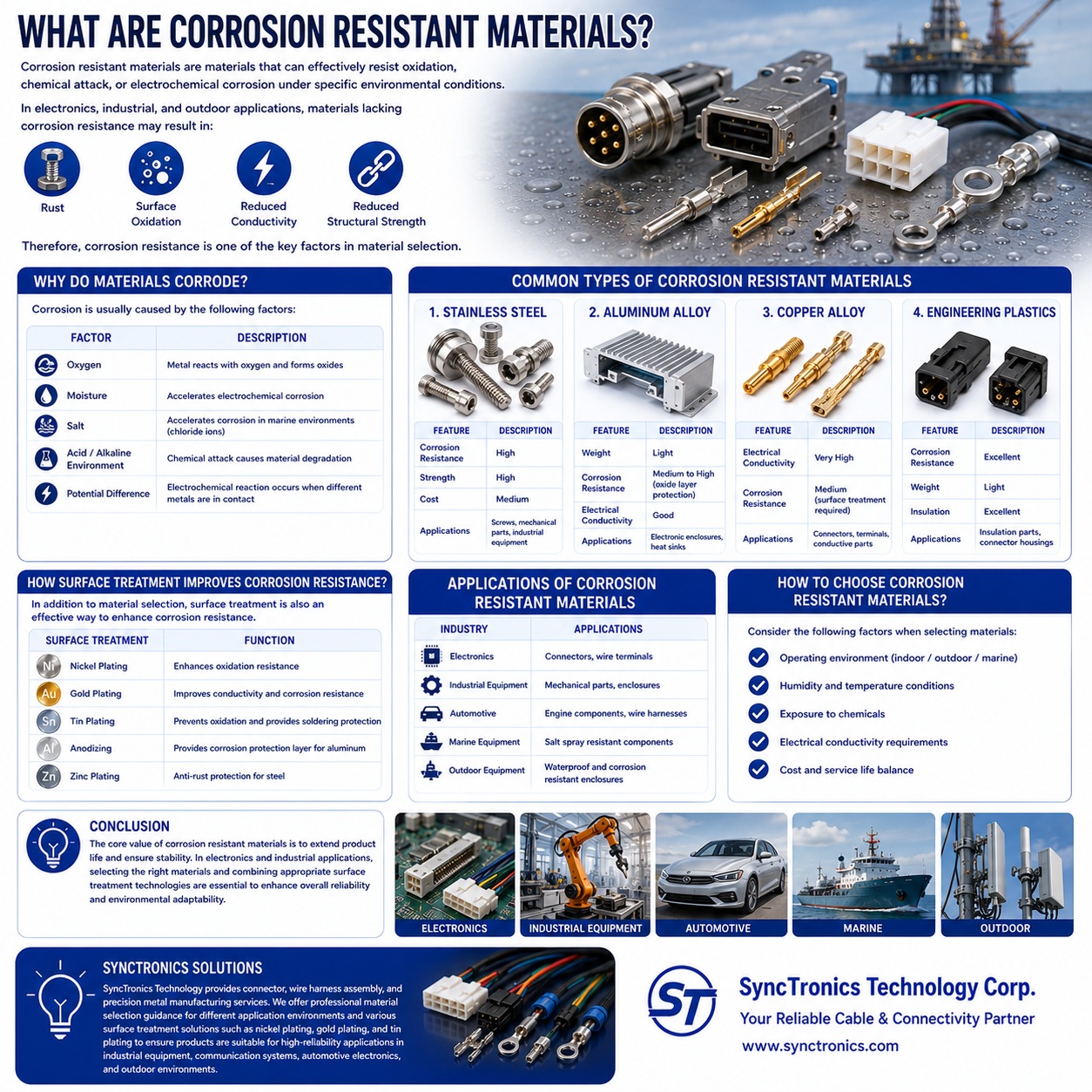
In electronics and industrial applications, insufficient corrosion resistance may lead to:
- Rust formation
- Surface oxidation
- Reduced conductivity
- Loss of mechanical strength
Therefore, corrosion resistance is a critical factor in material selection.
Why Does Corrosion Occur?
Corrosion is typically caused by the following factors:
|
Factor |
Description |
|
Oxygen |
Metal reacts with oxygen to form oxides |
|
Moisture |
Accelerates electrochemical corrosion |
|
Salt |
Chloride ions in marine environments speed up corrosion |
|
Acid/Base Environment |
Chemical attack on material surface |
|
Electrical Potential Difference |
Galvanic corrosion between dissimilar metals |
Common Corrosion-Resistant Materials
1. Stainless Steel
One of the most widely used corrosion-resistant metals.
|
Property |
Description |
|
Corrosion Resistance |
High |
|
Strength |
High |
|
Cost |
Medium |
|
Applications |
Screws, mechanical parts, industrial equipment |
2. Aluminum Alloys
|
Property |
Description |
|
Weight |
Lightweight |
|
Corrosion Resistance |
Medium to High (oxide layer protection) |
|
Conductivity |
Good |
|
Applications |
Electronic housings, heat sinks |
3. Copper Alloys
|
Property |
Description |
|
Conductivity |
Very high |
|
Corrosion Resistance |
Moderate (requires surface treatment) |
|
Applications |
Connectors, terminals, conductive components |
4. Engineering Plastics
|
Property |
Description |
|
Corrosion Resistance |
Excellent |
|
Weight |
Lightweight |
|
Electrical Insulation |
Excellent |
|
Applications |
Insulating parts, connector housings |
How Surface Treatments Improve Corrosion Resistance
In addition to base materials, surface treatments significantly enhance corrosion resistance:
|
Surface Treatment |
Function |
|
Nickel Plating |
Improves oxidation resistance |
|
Gold Plating |
Enhances conductivity and corrosion resistance |
|
Tin Plating |
Prevents oxidation and supports solderability |
|
Anodizing |
Protective oxide layer for aluminum |
|
Zinc Plating |
Anti-rust protection for steel |
Applications of Corrosion-Resistant Materials
|
Industry |
Applications |
|
Electronics |
Connectors, cable terminals |
|
Industrial Equipment |
Mechanical parts, enclosures |
|
Automotive |
Engine components, wiring harnesses |
|
Marine Applications |
Salt spray-resistant structures |
|
Outdoor Equipment |
Weather-resistant housings |
How to Select Corrosion-Resistant Materials
Key factors in material selection include:
- Operating environment (indoor / outdoor / marine)
- Humidity and temperature conditions
- Exposure to chemicals
- Electrical conductivity requirements
- Cost vs. service life balance
Conclusion
The value of corrosion-resistant materials lies in extending product lifespan and ensuring long-term reliability. In electronics and industrial applications, selecting the right base material combined with appropriate surface treatment is essential for achieving optimal durability and environmental resistance.
SyncTronics Solutions
SyncTronics Technology provides connector manufacturing, wire harness assembly, and precision metal component solutions. We support customers in selecting appropriate corrosion-resistant materials based on application environments and offer surface treatment options such as nickel, gold, and tin plating. Our solutions are designed for industrial, telecommunications, automotive, and outdoor high-reliability applications.
Need Wire Harnesses, Connectors,
Electromechanical Components, or Custom Solutions? Contact Us Today
Whether you are looking for connectors,
cables, wire harness assemblies, electromechanical components, or complete
electronic interconnect solutions, SyncTronics provides professional technical
support and engineering evaluation for product selection, specification
verification, New Product Introduction (NPI), OEM/ODM customization, as well as
high-speed transmission, high-reliability, and other specialized application
requirements.
We welcome you to visit our Contact Us page and
share your project requirements and contact information. Our team is committed
to responding quickly and professionally, evaluating the most suitable
products and electronic interconnect solutions based on your product
specifications, application requirements, and project objectives. We also
provide technical recommendations and customized engineering support to help
shorten product selection and development time, reduce project risks, and
accelerate your path to mass production. We look forward to the opportunity to
work with you and provide reliable technical support and practical solutions
for every stage of your project.
Related Articles
What Is Metal Surface Treatment? Complete Guide | SyncTronics Technology
Disclaimer and Technical Exchange Statement
This content is compiled based on publicly
available information and industry experience, intended solely for reference
during technical exchanges. It does not constitute any commercial, technical,
or legal advice or basis.
The specifications, materials, manufacturing processes, application methods,
and related information described herein may vary due to differing design
conditions, environmental factors, or usage scenarios. No guarantees are made
regarding the completeness, correctness, or suitability of such content.
Readers should verify the suitability with the responsible design or technical
personnel based on actual application scenarios, and independently assess all
associated risks.
Frequently Asked Questions (FAQ)
- What is Connector Knowledge
- Wire Related issues
- Materials-Related
- What Is Thermoplastic (TP)? Terminal Block Materials & Selection Explained
- PVC vs. PUR Cable Jackets: Differences and Selection Guide
- What Is Beryllium Copper? Connector Terminal Material Properties and Applications
- What Is Phosphor Bronze? Connector Terminal Material Explained
- What Is Metal Surface Treatment? Complete Guide
- What Is Electroplating Grade? A Complete Guide to Plating Thickness and Quality Standards
- What Is Plating Thickness? How Does It Affect Product Quality and Service Life?
- What Are Gold, Tin, and Nickel Plating? Understanding the Differences Between Common Metal Plating Finishes
- Why Does Electroplating Price Vary So Much? Understanding MOQ, Plating Thickness, and Processing Costs
- What Are Corrosion-Resistant Materials? Complete Guide to Material Properties and Applications
- Common Connector Materials Explained: Applications of LCP, PBT, ABS, and Nylon 6T
- What Are LCP, PBT, ABS, and Nylon 6T? Material Comparison Guide
- What Are Halogen-Free Materials and Halogen-Free Processes? Complete Guide to Halogen Free (HF)
- What Is Halogen-Free Material? Complete Guide to Halogen-Free (HF) Materials
- What Is PPS Material? Complete Guide to Properties and Applications
- What Is PA66 Material? Complete Guide to Nylon 66 Properties and Applications
- What Are High-Temperature Engineering Plastics? Complete Guide to High-Performance Plastic Materials
- What Are Flame Retardant Materials? Complete Guide to Flame Ratings and Applications
- What Are Insulation Materials? Complete Guide to Electrical Insulation Materials
- What Are Conductive Materials? Complete Guide to Types and Applications
- What Are Rare Earth Elements? A Complete Guide to Industrial Raw Materials, Rare Metals, and Critical Minerals
- Regulatory Issues
- Electronic issues
- Manufacturing Technology
- Testing & Verification
- Quality Management
- History & Evolution