
RJ45 Connector Structure and Applications Guide
What Is an RJ45 Connector? Complete Guide to RJ45 Connector Structure and Applications
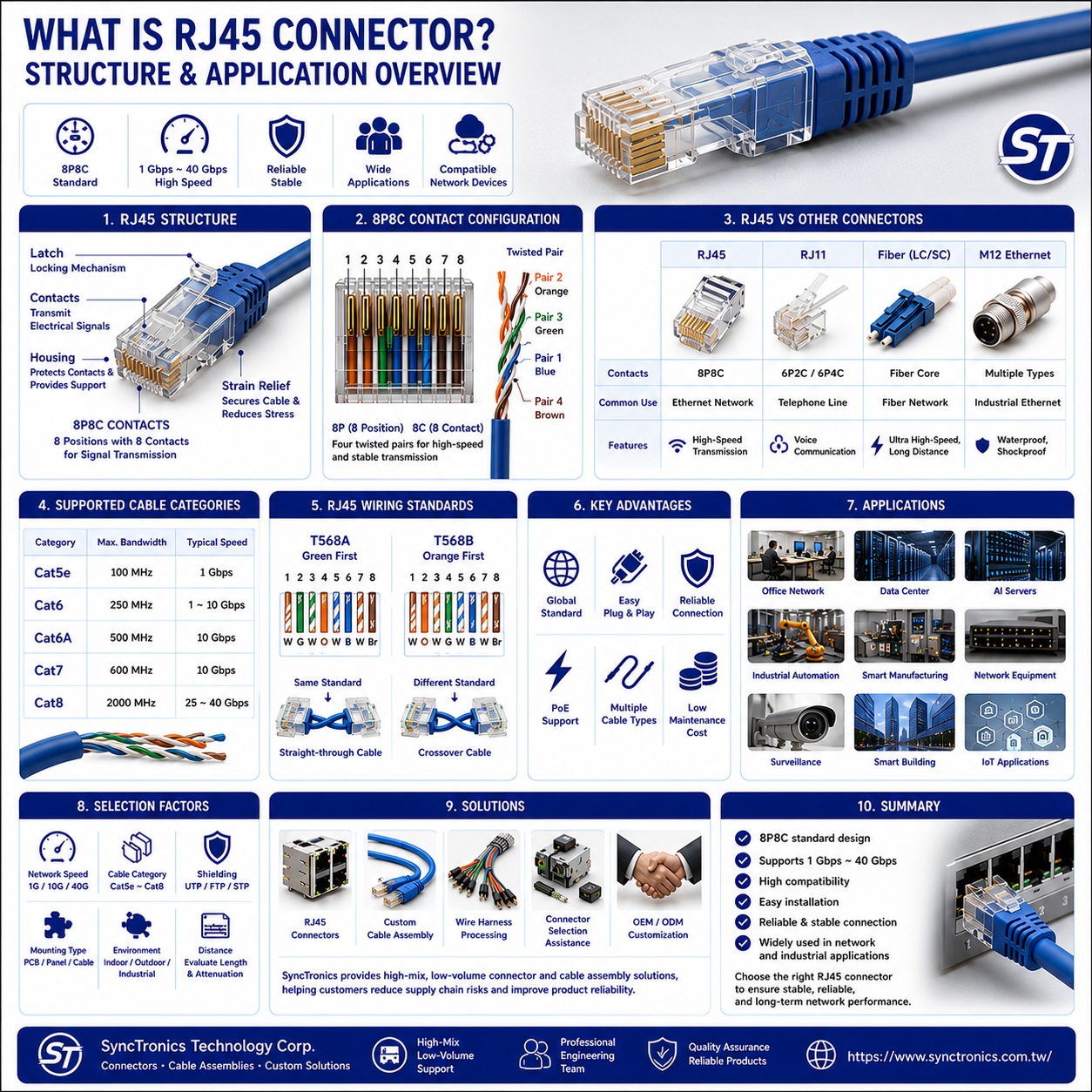
An RJ45 connector is one of the most commonly used Ethernet connectors for wired network communication. It is widely applied in computers, switches, routers, servers, industrial equipment, and various network communication systems. Although commonly referred to as an RJ45 connector, most modern Ethernet connectors are actually based on the 8P8C (8 Position 8 Contact) modular connector structure. RJ45 connectors can be used with different categories of Ethernet cables, including Cat5e, Cat6, Cat6A, Cat7, and Cat8, supporting network speeds ranging from 100 Mbps to 40 Gbps depending on the overall system design.
What Is an RJ45 Connector?
RJ45 (Registered Jack 45) is a standardized modular connector commonly used for Ethernet networking applications. It features a plastic housing, metal contacts, and a locking mechanism that enables reliable connection between network devices.
Technically speaking, many connectors called “RJ45” today are actually 8P8C connectors. The term RJ45 has become a common industry name because of its widespread use in Ethernet applications.
The RJ45 connector has become the standard interface for wired networks due to its high compatibility, reliable signal transmission, easy installation, and cost efficiency.
RJ45 Connector Structure
An RJ45 connector consists of several key components that work together to provide stable electrical and mechanical performance.
|
Component |
Function |
|
Housing |
Protects internal contacts and provides mechanical support |
|
Metal Contacts |
Establish electrical connection for signal transmission |
|
Latch |
Locks the connector in place to prevent accidental disconnection |
|
Cable Strain Relief |
Reduces stress on the cable connection point |
|
8P8C Contacts |
Provides eight conductive positions for Ethernet signals |
The connector design allows users to quickly connect and disconnect network cables while maintaining stable mechanical retention.
What Does 8P8C Mean in RJ45?
8P8C is the most common contact configuration used in RJ45 Ethernet connectors.
- 8P (8 Positions): The connector contains eight available contact positions.
- 8C (8 Contacts): All eight positions include electrical contacts.
These eight contacts correspond to four twisted pairs inside an Ethernet cable, enabling reliable high-speed data transmission.
RJ45 vs. Other Common Network Connectors
Different network connectors are designed for different communication environments and applications.
|
Connector |
Contact Configuration |
Common Applications |
Characteristics |
|
RJ45 |
8P8C |
Ethernet networking |
High-speed data communication |
|
RJ11 |
6P2C / 6P4C |
Telephone systems |
Voice communication |
|
LC / SC Fiber Connector |
Optical fiber interface |
Fiber networks |
High bandwidth and long-distance transmission |
|
M12 Ethernet Connector |
Various configurations |
Industrial Ethernet |
High protection against vibration and harsh environments |
RJ45 is mainly used in commercial networks, offices, and data centers, while industrial environments may require more ruggedized connectors with enhanced protection.
Ethernet Cable Categories Supported by RJ45
RJ45 connectors can be used with different categories of twisted-pair Ethernet cables. The cable category directly affects bandwidth capability and supported transmission speed.
|
Cable Category |
Maximum Bandwidth |
Common Transmission Speed |
|
Cat5e |
100 MHz |
1 Gbps |
|
Cat6 |
250 MHz |
1–10 Gbps |
|
Cat6A |
500 MHz |
10 Gbps |
|
Cat7 |
600 MHz |
10 Gbps |
|
Cat8 |
2000 MHz |
25–40 Gbps |
Actual network performance depends on various factors, including connector quality, cable length, equipment specifications, and installation conditions.
RJ45 Wiring Standards
RJ45 Ethernet cables commonly follow two wiring standards:
|
Wiring Standard |
Characteristics |
Common Usage |
|
T568A |
Uses green pair arrangement first |
Some government and structured cabling applications |
|
T568B |
Uses orange pair arrangement first |
Most commonly used Ethernet wiring standard |
When both ends of a cable use the same wiring standard, it forms a straight-through cable. Traditional crossover cables use different wiring standards on each end, although many modern Ethernet devices support Auto MDI-X for automatic configuration.
Advantages of RJ45 Connectors
RJ45 connectors remain the dominant Ethernet interface due to several advantages:
- High global compatibility through standardized design
- Easy installation and replacement
- Reliable signal transmission
- Support for Power over Ethernet (PoE)
- Compatibility with various Ethernet cable categories
- Low maintenance and replacement costs
These advantages make RJ45 connectors suitable for enterprise networks, industrial systems, and modern communication equipment.
Common Applications of RJ45 Connectors
RJ45 connectors are widely used across different industries and networking applications.
|
Application Area |
Usage Examples |
|
Office Networking |
Computers, switches, routers |
|
Data Centers |
Servers and high-speed network equipment |
|
AI Servers |
Management networks and control systems |
|
Industrial Automation |
Industrial Ethernet devices |
|
Smart Manufacturing |
PLCs, controllers, HMIs |
|
Network Equipment |
Gateways, firewalls, switches |
|
Security Systems |
IP cameras and NVR systems |
|
Smart Buildings |
IoT devices, access control, smart systems |
With the continued growth of AI computing, smart factories, IoT applications, and high-speed networking, RJ45 connectors remain a critical interface in modern communication systems.
How to Select the Right RJ45 Connector?
When selecting an RJ45 connector, several key factors should be considered:
|
Selection Factor |
Considerations |
|
Network Speed |
Confirm support for 1G, 10G, or higher transmission requirements |
|
Cable Category |
Match with Cat5e, Cat6, Cat6A, or higher-grade cables |
|
Shielding Requirements |
Evaluate UTP, FTP, or STP designs |
|
Mounting Method |
Consider PCB mount, panel mount, or cable assembly |
|
Operating Environment |
Evaluate waterproof, dustproof, or industrial requirements |
|
Transmission Distance |
Consider cable length and signal attenuation |
For industrial equipment, high-speed networking systems, or specialized applications, additional factors such as EMI protection, mating cycles, contact resistance, and material reliability should also be evaluated.
Application Solutions
RJ45 connectors are widely used in networking equipment, AI servers, industrial automation systems, smart manufacturing, surveillance systems, and various Ethernet-based applications. Different applications may require specific solutions regarding transmission speed, shielding performance, mechanical design, durability, and environmental reliability.
SyncTronics Technology specializes in high-mix, low-volume connector and cable solutions, providing customized RJ45 connector solutions, Ethernet cable assemblies, wire harness processing, connector selection support, and OEM/ODM manufacturing services.
With experience in electronic interconnect solutions, SyncTronics Technology supports customers across networking, industrial control, AI computing, and electronic equipment applications by providing flexible manufacturing capabilities and customized engineering support.
Summary
RJ45 connectors are among the most widely used Ethernet interfaces in modern communication systems. Based on the 8P8C structure, RJ45 connectors support various Ethernet cable categories and can meet different networking requirements, from standard 1 Gbps connections to advanced high-speed applications.
When selecting an RJ45 connector, engineers should consider not only transmission speed but also cable category, shielding design, mounting method, environmental conditions, and long-term reliability requirements to ensure stable network performance.
Need Wire Harnesses, Connectors, Electromechanical Components, or Custom Solutions? Contact Us Today
Whether you are looking for connectors, cables, wire harness assemblies, electromechanical components, or complete electronic interconnect solutions, SyncTronics provides professional technical support and engineering evaluation for product selection, specification verification, New Product Introduction (NPI), OEM/ODM customization, as well as high-speed transmission, high-reliability, and other specialized application requirements.
We welcome you to visit our Contact Us page and share your project requirements and contact information. Our team is committed to responding quickly and professionally, evaluating the most suitable products and electronic interconnect solutions based on your product specifications, application requirements, and project objectives. We also provide technical recommendations and customized engineering support to help shorten product selection and development time, reduce project risks, and accelerate your path to mass production. We look forward to the opportunity to work with you and provide reliable technical support and practical solutions for every stage of your project.
Related Articles:
CAT5e vs CAT6 vs CAT6A vs CAT7 vs CAT8 Guide | SyncTronics Technology
RJ45 Connector Structure and Applications Guide | 8P8C Explained|SyncTronics Technology
CAT3 vs CAT4 vs CAT5 Ethernet Cable Guide | SyncTronics Technology
Disclaimer and Technical Exchange Statement
This content is compiled based on publicly
available information and industry experience, intended solely for reference
during technical exchanges. It does not constitute any commercial, technical,
or legal advice or basis.
The specifications, materials, manufacturing processes, application methods,
and related information described herein may vary due to differing design
conditions, environmental factors, or usage scenarios. No guarantees are made
regarding the completeness, correctness, or suitability of such content.
Readers should verify the suitability with the responsible design or technical
personnel based on actual application scenarios, and independently assess all
associated risks.
Frequently Asked Questions (FAQ)
- What is Connector Knowledge
- What Is a Connector?
- Euro-Style vs. Barrier Terminal Blocks
- Ring vs. Fork Terminals: Differences
- What Is an IDC Connector?
- Box Header vs. Ejector Header: Latching, Ejection, and When to Use Each
- What Is a Box Header?
- 6 Common Connector Selection Mistakes and How to Avoid Them
- How to Select a USB Type-C Connector: Mating Cycles, Current Rating & PCB Mounting
- How to Select Industrial Automation Connectors: Locking, Vibration Resistance & Retention
- How to Select Energy Storage Connectors: Current Rating, Contact Resistance & Keying
- Why Do High-Current Connectors Overheat? Contact Resistance, Terminals & Crimp Quality
- What Is a Terminal Block? Types, Structure & Selection
- Wire-to-Board vs. Board-to-Board Connectors: Structure and Selection
- How to Select Drone Connectors and Wire Harnesses: Power, Flight Controller, GPS and Signal Connections
- What Connectors Are Commonly Used in Drones? XT30, XT60, JST-GH, and DF13 Explained
- How to Select Drone Battery Connectors: XT30, XT60 and XT90
- Why Do Drone Connectors Become Loose? Vibration Resistance, Polarization and Retention Design
- RJ45 Connector Structure and Applications Guide
- What Is Connector Pitch?
- What Does Connector Pin Count Mean?
- What Is the Difference Between a Terminal, a Connector, and a Coupling?
- What Is Contact Resistance, and What Does It Affect?
- What Is Connector Insertion and Withdrawal Force?
- What Is Retention Force?
- What Is Poka-Yoke (Error-Proofing) Design?
- What Is Gold Plating Thickness? Why Does It Affect Connector Lifespan?
- What Is the Difference Between SMT Connectors and DIP Connectors?
- Wire Related issues
- Materials-Related
- Regulatory Issues
- Electronic issues
- Manufacturing Technology
- Testing & Verification
- Quality Management
- History & Evolution