
What Are CoC and CoA?
What Are CoC and CoA? Understanding the Differences Between Certificate of Conformance and Certificate of Analysis
Certificate of Conformance (CoC) and Certificate of Analysis (CoA) are two of the most commonly requested quality documents in manufacturing and global supply chains.
Although both documents are frequently provided during product delivery, they serve different purposes.
- CoC certifies that a product complies with specified requirements or standards.
- CoA provides the actual inspection or laboratory test results for a product or material.
Understanding the differences between these documents helps purchasing teams, quality engineers, suppliers, and customers ensure proper quality verification during product acceptance.
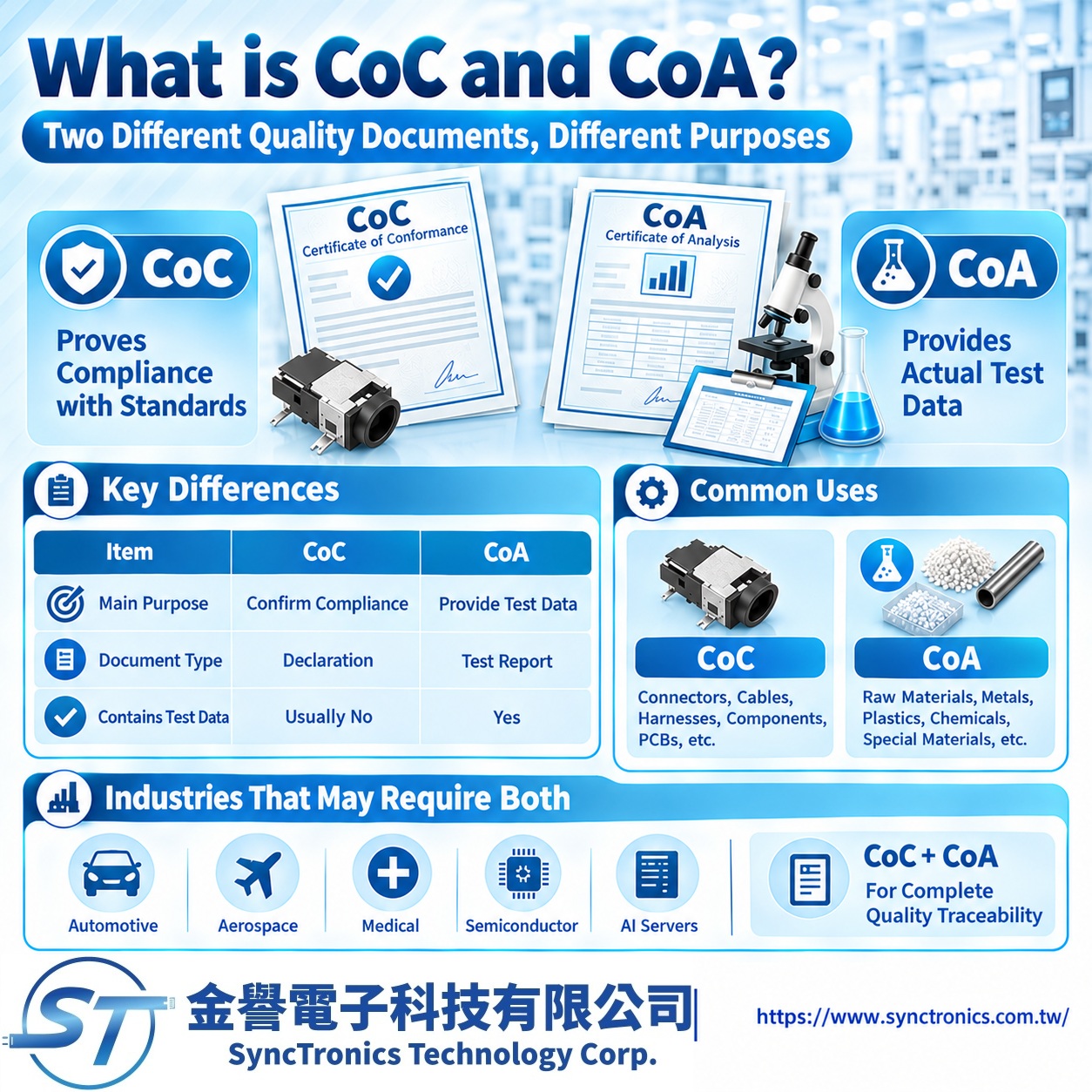
What Is a CoC?
A Certificate of Conformance (CoC) is an official document issued by a manufacturer or supplier stating that a product complies with the customer's specifications, engineering drawings, contractual requirements, or applicable industry standards.
A typical CoC may include:
- Manufacturer information
- Product name
- Part number
- LOT number
- Date Code
- Specification or drawing revision
- Applicable standards
- Authorized signature
A CoC focuses on declaring compliance, rather than providing detailed inspection data.
What Is a CoA?
A Certificate of Analysis (CoA) is a quality document that records the actual inspection or laboratory test results for a product or material.
Typical contents include:
- Inspection items
- Specification limits
- Measured values
- Test methods
- Pass/Fail results
- Inspection date
- Inspector or laboratory information
Unlike a CoC, a CoA emphasizes actual test data that demonstrates product quality.
What Is the Difference Between CoC and CoA?
|
Item |
CoC |
CoA |
|
Full Name |
Certificate of Conformance |
Certificate of Analysis |
|
Primary Purpose |
Certify compliance with specifications |
Provide actual inspection or test results |
|
Test Data Included |
Usually No |
Yes |
|
Document Type |
Compliance declaration |
Inspection or laboratory report |
|
Typical Use |
Product shipment and customer acceptance |
Material verification and quality validation |
The key difference is that a CoC declares compliance, while a CoA provides measurable inspection results.
When Is a CoC Required?
A CoC is commonly requested for:
- Connectors
- Cables
- Wire harnesses
- Electronic components
- Printed circuit boards (PCBs)
- Industrial equipment
- OEM and ODM products
- International shipments
Many customers require a CoC to verify that supplied products conform to purchase specifications.
When Is a CoA Required?
A CoA is frequently requested for:
- Raw materials
- Metal materials
- Plastic materials
- Chemical materials
- Plating materials
- Specialty electronic materials
- High-reliability products
Whenever customers require actual inspection data rather than a compliance declaration, a CoA is typically requested.
Are Both CoC and CoA Required?
Yes, in some industries.
High-reliability industries such as:
- Automotive electronics
- Aerospace
- Medical devices
- Semiconductor equipment
- AI servers
may require suppliers to provide both:
- CoC for specification compliance
- CoA for inspection verification
This helps establish complete product traceability and quality documentation.
How Are CoC and CoA Different from RoHS and REACH?
These documents are often confused, but they serve different purposes.
|
Document |
Primary Purpose |
|
CoC |
Product compliance declaration |
|
CoA |
Inspection and laboratory results |
|
RoHS |
Restriction of hazardous substances compliance |
|
REACH |
Chemical substance regulatory compliance |
RoHS and REACH are regulatory compliance documents, whereas CoC and CoA are quality management documents.
Conclusion
Certificate of Conformance (CoC) and Certificate of Analysis (CoA) are both essential quality documents used throughout global supply chains, but they serve different functions. A CoC confirms that products comply with specifications, while a CoA provides actual inspection or laboratory test results. Depending on product type, customer requirements, and industry regulations, manufacturers may need to provide one or both documents to ensure product quality, regulatory compliance, and complete traceability.
SyncTronics Solutions
SyncTronics Technology provides connector and cable application solutions that support high-mix, low-volume production as well as diverse application requirements. Based on customer application needs, we assist in evaluating suitable connectors, cables, and product specifications while supporting documentation related to product specifications, quality records, material consistency, and reliability. Our solutions help industrial equipment manufacturers, telecommunications companies, AI server providers, and other electronics industries establish more complete quality management and supply chain documentation systems.
Need Wire Harnesses, Connectors, Electromechanical Components, or Custom Solutions? Contact Us Today
Whether you are looking for connectors,
cables, wire harness assemblies, electromechanical components, or complete
electronic interconnect solutions, SyncTronics provides professional technical
support and engineering evaluation for product selection, specification
verification, New Product Introduction (NPI), OEM/ODM customization, as well as
high-speed transmission, high-reliability, and other specialized application
requirements.
We welcome you to visit our Contact Us page
and share your project requirements and contact information. Our team is
committed to responding quickly and professionally, evaluating the most
suitable products and electronic interconnect solutions based on your product
specifications, application requirements, and project objectives. We also
provide technical recommendations and customized engineering support to help
shorten product selection and development time, reduce project risks, and
accelerate your path to mass production. We look forward to the opportunity to
work with you and provide reliable technical support and practical solutions
for every stage of your project.
Related Articles:
What Is RoHS 2.0? EU Hazardous Substances Restriction Explained | SyncTronics Technology
What Is Halogen Free (HF)? A Complete Guide to Halogen-Free Standards | SyncTronics Technology
What Is UL94? Flammability Ratings & Plastic Fire Resistance Explained | SyncTronics Technology
Disclaimer and Technical Exchange StatementThis content is compiled based on publicly available information and industry experience, intended solely for reference during technical exchanges. It does not constitute any commercial, technical, or legal advice or basis.
The specifications, materials, manufacturing processes, application methods, and related information described herein may vary due to differing design conditions, environmental factors, or usage scenarios. No guarantees are made regarding the completeness, correctness, or suitability of such content.
Readers should verify the suitability with the responsible design or technical personnel based on actual application scenarios, and independently assess all associated risks.
Frequently Asked Questions (FAQ)
- What is Connector Knowledge
- Wire Related issues
- Materials-Related
- Regulatory Issues
- Electronic issues
- Manufacturing Technology
- Testing & Verification
- Quality Management
- MOQ vs. MPQ vs. SPQ
- What Is NCNR?
- What Is an LOA (Letter of Authorization)?
- ECR vs. ECN: How the Engineering Change Process Works
- How Is Material Traceability Managed for Energy Storage Wire Harnesses? Lot, Wire & Terminal Control
- What Is PPAP? A Complete Guide to the Production Part Approval Process
- What Are EOL and PCN?
- What Is Incoming Quality Control (IQC)?
- What Is In-Process Quality Control (IPQC)?
- What Is Outgoing Quality Control (OQC)?
- What Is AQL (Acceptable Quality Level)?
- What Are CoC and CoA?
- What Is Material Traceability?
- What Is a Date Code (D/C)?
- What Are LOT Numbers and BIN Codes?
- What Is FMEA (Failure Mode and Effects Analysis)?
- What Is an 8D Report?
- What Is Six Sigma?
- What Are Cp and Cpk?
- What Is a Control Plan?
- What Is ISO 9001?
- What Is IATF 16949?
- History & Evolution