
What Is the Difference Between a Terminal, a Connector, and a Coupling?
The terms terminal, connector, and coupling are often used together, but they do not mean exactly the same thing.
In simple terms:
- Terminal: usually refers to a metal contact or wire-end component used for conduction, crimping, or soldering.
- Coupling: a broader term for a part or point that joins two wires or components together.
- Connector: a complete connectable system, usually designed to mate and unmate, and often consisting of a housing, terminals, and locking features.
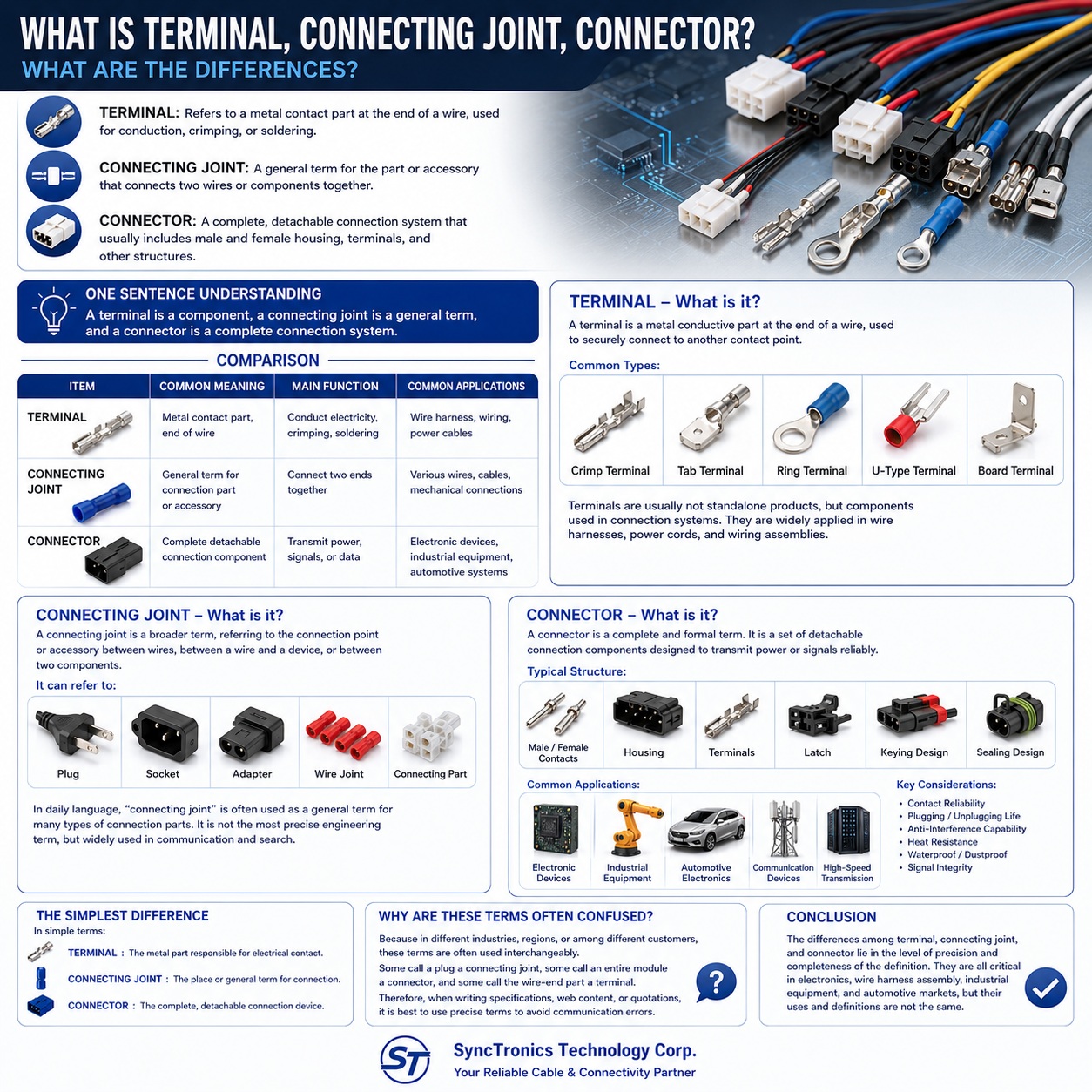
A terminal is a component, a coupling is a general term, and a connector is a complete connection system.
What Is a Terminal?
A terminal is usually a metal conductive part at the end of a wire, used to make an electrical connection to another point. Common types include:
- Crimp terminals
- Spade terminals
- Ring terminals
- U-shaped terminals
- Board terminals
A terminal is usually not a complete product by itself. It is one part of a larger wire connection system and is widely used in wire harnesses, power cables, and electrical wiring.
What Is a Coupling?
A coupling is a more general term. It is often used to describe the point, part, or accessory that joins two wires, a wire and a device, or two components together. In everyday usage, people may use “coupling” to refer to:
- Plug-in joints
- Socket joints
- Adapters
- Wire-end junctions
- Connection accessories
Because it is a broader term, “coupling” is less precise than terminal or connector, but it is still commonly used in daily communication and search queries.
What Is a Connector?
A connector is the most complete and formal term. It usually refers to a plug-and-socket style assembly that allows electrical power or signals to be transferred reliably. A connector often includes:
- Male and female parts
- Housing
- Terminals
- Latches
- Alignment features
- Keying or anti-misplug design
Connectors are widely used in:
- Electronic products
- Industrial control equipment
- Automotive systems
- Communication devices
- High-speed transmission applications
The main purpose of a connector is not only to “connect,” but also to ensure:
- Contact reliability
- Mating cycle life
- Interference resistance
- Heat resistance
- Water and dust protection
- Signal integrity
The Simplest Difference
In plain language:
- Terminal: the metal part that makes electrical contact
- Coupling: a general term for something that joins two parts together
- Connector: a complete plug-and-mate connection device
Why Are These Terms So Easy to Confuse?
These three terms are often mixed up
because different industries, regions, and customers use them differently.
For example, some people call a plug a coupling, some call a complete module a
connector, and some simply refer to a wire-end part as a terminal.
That is why, when writing product specifications, website content, or quotation documents, it is better to use the most precise term possible to avoid confusion.
Summary
The difference
between terminal, coupling, and connector mainly lies in precision and
completeness.
A terminal is a component, a coupling is a general term, and a connector is a
complete connection system. For electronics, wire harness manufacturing,
industrial equipment, and automotive applications, all three are important, but
their meanings and uses are not the same.
Need Wire Harnesses, Connectors, Electromechanical Components, or Custom Solutions? Contact Us Today
Whether you are looking for connectors, cables, wire harness assemblies, electromechanical components, or complete electronic interconnect solutions, SyncTronics provides professional technical support and engineering evaluation for product selection, specification verification, New Product Introduction (NPI), OEM/ODM customization, as well as high-speed transmission, high-reliability, and other specialized application requirements.
We welcome you to visit our Contact Us page and share your project requirements and contact information. Our team is committed to responding quickly and professionally, evaluating the most suitable products and electronic interconnect solutions based on your product specifications, application requirements, and project objectives. We also provide technical recommendations and customized engineering support to help shorten product selection and development time, reduce project risks, and accelerate your path to mass production. We look forward to the opportunity to work with you and provide reliable technical support and practical solutions for every stage of your project.
Related Articles:
Disclaimer and Technical Exchange Statement
This content is compiled based on publicly
available information and industry experience, intended solely for reference
during technical exchanges. It does not constitute any commercial, technical,
or legal advice or basis.
The specifications, materials, manufacturing processes, application methods,
and related information described herein may vary due to differing design
conditions, environmental factors, or usage scenarios. No guarantees are made
regarding the completeness, correctness, or suitability of such content.
Readers should verify the suitability with the responsible design or technical
personnel based on actual application scenarios, and independently assess all
associated risks.
Frequently Asked Questions (FAQ)
- What is Connector Knowledge
- What Is a Connector?
- Euro-Style vs. Barrier Terminal Blocks
- Ring vs. Fork Terminals: Differences
- What Is an IDC Connector?
- Box Header vs. Ejector Header: Latching, Ejection, and When to Use Each
- What Is a Box Header?
- 6 Common Connector Selection Mistakes and How to Avoid Them
- How to Select a USB Type-C Connector: Mating Cycles, Current Rating & PCB Mounting
- How to Select Industrial Automation Connectors: Locking, Vibration Resistance & Retention
- How to Select Energy Storage Connectors: Current Rating, Contact Resistance & Keying
- Why Do High-Current Connectors Overheat? Contact Resistance, Terminals & Crimp Quality
- What Is a Terminal Block? Types, Structure & Selection
- Wire-to-Board vs. Board-to-Board Connectors: Structure and Selection
- How to Select Drone Connectors and Wire Harnesses: Power, Flight Controller, GPS and Signal Connections
- What Connectors Are Commonly Used in Drones? XT30, XT60, JST-GH, and DF13 Explained
- How to Select Drone Battery Connectors: XT30, XT60 and XT90
- Why Do Drone Connectors Become Loose? Vibration Resistance, Polarization and Retention Design
- RJ45 Connector Structure and Applications Guide
- What Is Connector Pitch?
- What Does Connector Pin Count Mean?
- What Is the Difference Between a Terminal, a Connector, and a Coupling?
- What Is Contact Resistance, and What Does It Affect?
- What Is Connector Insertion and Withdrawal Force?
- What Is Retention Force?
- What Is Poka-Yoke (Error-Proofing) Design?
- What Is Gold Plating Thickness? Why Does It Affect Connector Lifespan?
- What Is the Difference Between SMT Connectors and DIP Connectors?
- Wire Related issues
- Materials-Related
- Regulatory Issues
- Electronic issues
- Manufacturing Technology
- Testing & Verification
- Quality Management
- History & Evolution