
What Is a Shielded Cable? Why Does It Reduce Electromagnetic Interference?
What Is a Shielded Cable?
A shielded cable is a cable that includes one or more conductive shielding layers surrounding the internal conductors. These shielding layers help block Electromagnetic Interference (EMI) and Radio Frequency Interference (RFI) while also reducing electromagnetic emissions generated by the cable itself.
Compared with unshielded cables, shielded cables provide more stable signal transmission and are widely used in high-speed communications, industrial automation, medical equipment, and automotive electronics.
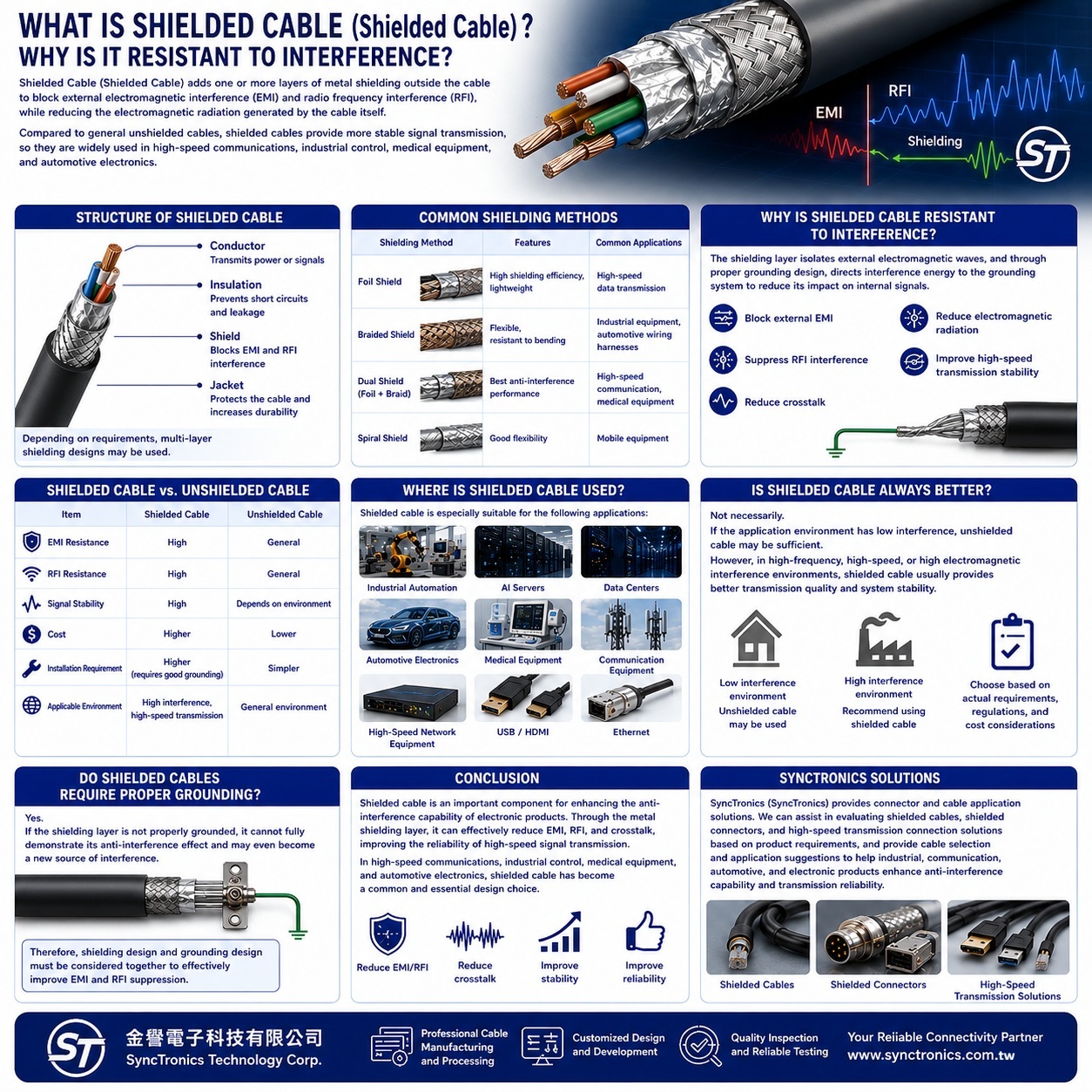
Basic Structure of a Shielded Cable
A typical shielded cable consists of the following components:
|
Component |
Function |
|
Conductor |
Transmits electrical power or signals |
|
Insulation |
Prevents short circuits and electrical leakage |
|
Shield Layer |
Reduces EMI and RFI interference |
|
Outer Jacket |
Protects the cable from mechanical damage and environmental conditions |
Some cables use multiple shielding layers to achieve even better electromagnetic protection.
Common Types of Cable Shielding
|
Shield Type |
Characteristics |
Typical Applications |
|
Foil Shield |
Excellent shielding coverage and lightweight |
High-speed data transmission |
|
Braided Shield |
Flexible with high mechanical durability |
Industrial equipment, automotive wiring |
|
Foil + Braided Shield |
Superior EMI/RFI protection |
Medical devices, communication equipment, data centers |
|
Spiral Shield |
Highly flexible |
Robotic and movable cable systems |
Why Do Shielded Cables Reduce Interference?
The conductive shield acts as a barrier that blocks external electromagnetic fields from reaching the signal conductors. When properly grounded, it also directs unwanted electromagnetic energy away from the cable.
Key benefits include:
- Reduces external EMI
- Suppresses RFI
- Minimizes signal crosstalk
- Reduces electromagnetic radiation
- Improves high-speed signal integrity
Shielded Cable vs. Unshielded Cable
|
Feature |
Shielded Cable |
Unshielded Cable |
|
EMI Protection |
Excellent |
Standard |
|
RFI Protection |
Excellent |
Standard |
|
Signal Stability |
High |
Depends on the environment |
|
Cost |
Higher |
Lower |
|
Installation Requirements |
Requires proper grounding |
Simpler installation |
|
Best Applications |
High-speed or high-interference environments |
General-purpose applications |
Where Are Shielded Cables Commonly Used?
Shielded cables are commonly used in:
- Industrial automation systems
- AI servers
- Data centers
- Automotive electronics
- Medical equipment
- Telecommunications equipment
- High-speed networking devices
- USB, HDMI, Ethernet, and other high-speed interfaces
Are Shielded Cables Always Better?
Not necessarily.
For environments with little electromagnetic interference, an unshielded cable may provide sufficient performance at a lower cost.
However, in high-frequency, high-speed, or electrically noisy environments, shielded cables generally offer better transmission quality, improved reliability, and greater system stability.
The most suitable cable should be selected based on the application environment, performance requirements, regulatory compliance, and budget.
Does a Shielded Cable Need Proper Grounding?
Yes.
Without proper grounding, the shielding layer cannot effectively dissipate interference and may even become a source of additional electromagnetic noise.
For maximum performance, shielding and grounding should always be designed together.
Conclusion
Shielded cables play a critical role in improving electromagnetic compatibility by reducing EMI, RFI, and signal crosstalk. They are widely used in high-speed communication systems, industrial automation, automotive electronics, medical devices, and other applications where reliable signal transmission is essential.
SyncTronics Solutions
SyncTronics Technology provides connector and cable application solutions. Based on customer requirements, we assist in evaluating shielded cables, shielded connectors, and high-speed interconnection solutions while offering recommendations for cable selection and application design to improve interference resistance and transmission reliability in industrial, telecommunications, automotive, and electronic applications.
Need Wire Harnesses, Connectors,
Electromechanical Components, or Custom Solutions? Contact Us Today
Whether you are looking for connectors,
cables, wire harness assemblies, electromechanical components, or complete
electronic interconnect solutions, SyncTronics provides professional technical
support and engineering evaluation for product selection, specification
verification, New Product Introduction (NPI), OEM/ODM customization, as well as
high-speed transmission, high-reliability, and other specialized application
requirements.
We welcome you to visit our Contact Us page
and share your project requirements and contact information. Our team is
committed to responding quickly and professionally, evaluating the most
suitable products and electronic interconnect solutions based on your product
specifications, application requirements, and project objectives. We also
provide technical recommendations and customized engineering support to help
shorten product selection and development time, reduce project risks, and
accelerate your path to mass production. We look forward to the opportunity to
work with you and provide reliable technical support and practical solutions
for every stage of your project.
Related Articles
What Is a High-Speed Transmission Cable? Definition and Applications | SyncTronics Technology
What Is Crosstalk? Causes, Effects, and Prevention Methods Explained | SyncTronics Technology
What Is Grounding? Why Is It Important for EMI Reduction? Complete Guide | SyncTronics Technology
What Is Signal Integrity? High-Speed Signal Transmission Explained | SyncTronics Technology
What Is Cable Assembly? Complete Guide | SyncTronics Technology
Disclaimer and Technical Exchange Statement
This content is compiled based on publicly
available information and industry experience, intended solely for reference
during technical exchanges. It does not constitute any commercial, technical,
or legal advice or basis.
The specifications, materials, manufacturing processes, application methods,
and related information described herein may vary due to differing design
conditions, environmental factors, or usage scenarios. No guarantees are made
regarding the completeness, correctness, or suitability of such content.
Readers should verify the suitability with the responsible design or technical
personnel based on actual application scenarios, and independently assess all
associated risks.
Frequently Asked Questions (FAQ)
- What is Connector Knowledge
- Wire Related issues
- Materials-Related
- Regulatory Issues
- Electronic issues
- What Is the Relationship Between Electronics and Connecting Cables?
- What Is USB PD 3.1? How 240W USB-C Charging Works
- Drone Wire EMI: Power, Signal & Shielding
- What Are Drone Flight Controller Cables? GPS, CAN, UART, I²C and PWM Wiring Guide
- What Is High-Speed Signal Integrity (Signal Integrity, SI)?
- What Is RFI (Radio Frequency Interference)? How Is It Different from EMI?
- Why Are High-Speed Signals More Susceptible to EMI?
- What Is Crosstalk? Causes, Effects, and How to Reduce It
- What Is a Shielded Cable? Why Does It Reduce Electromagnetic Interference?
- What Is Grounding? Why Is It Important for Reducing EMI?
- What Is Signal Integrity? A Complete Guide to High-Speed Signal Transmission
- What Is EMI (Electromagnetic Interference)? How Does It Affect Electronic Products?
- What Is a Ferrite Core? How Does It Suppress EMI?
- How Does Cable Design Reduce EMI? A Complete Guide to EMI Shielding
- How to Reduce EMI and RFI? A Complete Guide to Electromagnetic Interference Mitigation
- Manufacturing Technology
- Testing & Verification
- Quality Management
- History & Evolution