
What Is Heat Shrink Tubing?
What Is Heat Shrink Tubing? Applications in Wire Harness Processing
Heat shrink tubing is an insulating and protective material that decreases in diameter when heated, allowing it to tightly cover wires, terminals, splices or electrical joints. It is commonly used in wire harness processing around soldered connections, wire splices, branch points, terminal ends and connector cable exits.
In addition to providing basic electrical insulation, heat shrink tubing can offer abrasion resistance, strain relief, moisture protection, identification and environmental sealing depending on its material and construction.
For this reason, heat shrink tubing is not simply used to “cover a wire.” It is an important part of wire harness reliability and protection design.
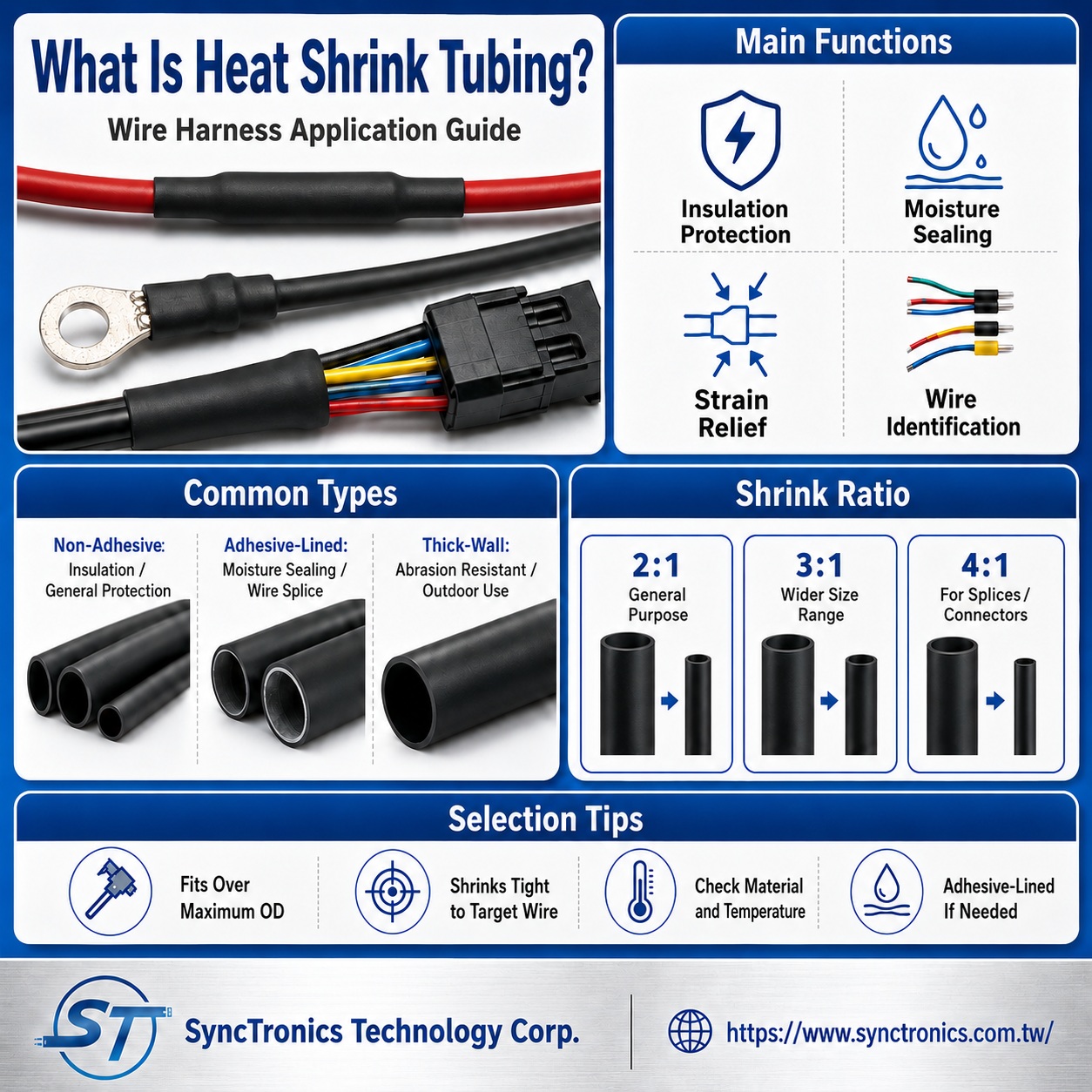
What Is Heat Shrink Tubing Used for in Wire Harnesses?
Common applications include:
- Covering solder joints and exposed conductors
- Improving electrical insulation
- Protecting wire splices and branch points
- Providing strain relief near cable exits
- Reducing abrasion and mechanical damage
- Identifying circuits, polarity or different harnesses
- Improving moisture resistance and sealing when adhesive-lined products are used
The actual function depends on the tubing material, wall thickness, shrink ratio and application environment.
What Is the Difference Between Adhesive-Lined and Non-Adhesive Heat Shrink Tubing?
Heat shrink tubing can generally be divided into single-wall non-adhesive and dual-wall adhesive-lined constructions.
|
Type |
Main Characteristics |
Common Applications |
|
Non-Adhesive Heat Shrink |
Thin, flexible and easy to process |
Insulation, identification and general harness protection |
|
Adhesive-Lined Heat Shrink |
Inner adhesive melts and fills gaps during heating |
Joint sealing, moisture protection and harness branches |
|
Thick-Wall / Protective Type |
Higher mechanical protection |
Industrial, outdoor and harsher environments |
When adhesive-lined heat shrink tubing is heated, the internal hot-melt adhesive softens and flows into gaps between the tubing and wire surface. This can improve moisture protection and environmental sealing around splices and branch points.
However, an adhesive-lined heat shrink tube does not automatically provide a specific IP67 or IP68 rating.
Actual waterproof performance depends on the complete combination of the wire, connector, sealing structure, processing conditions and finished assembly testing.
What Do 2:1, 3:1 and 4:1 Shrink Ratios Mean?
Heat shrink tubing is commonly specified with ratios such as 2:1, 3:1 or 4:1.
The shrink ratio describes the relationship between the expanded internal diameter and the fully recovered internal diameter.
For example, a 4:1 heat shrink tube can cover a relatively large connector, terminal or harness branch before shrinking down onto a much smaller cable diameter.
Commercial heat shrink tubing is available in shrink ratios such as:
- 1.5:1
- 2:1
- 3:1
- 4:1
- Higher ratios for specialized applications
A higher shrink ratio is not automatically better.
If the tubing is significantly larger than necessary, the finished wall thickness, processing time and material cost may increase unnecessarily. Selection should therefore be based on the actual dimensions of the component being covered.
How Should Heat Shrink Tubing Size Be Selected?
Two dimensions are especially important.
Expanded Inside Diameter
The tubing must be large enough before heating to pass over the connector, solder joint, terminal or largest section of the assembly.
Recovered Inside Diameter
After full shrinking, the internal diameter should be smaller than the component being covered so that the tubing can firmly grip the surface.
For example, many 3:1 and 4:1 products specify both the expanded and recovered inside diameters, allowing engineers to confirm whether the tubing can first pass over the largest section and then shrink tightly onto the final cable diameter.
For this reason, specifying only “5 mm heat shrink tubing” may not provide enough information.
It is better to confirm:
- Cable outer diameter
- Maximum connector or splice diameter
- Shrink ratio
- Required recovered wall thickness
- Required finished coverage length
Is Shrink Temperature the Same as Operating Temperature?
No.
Shrink temperature refers to the heating conditions required to begin or complete the shrinking process.
Operating temperature refers to the temperature range in which the tubing can be used after installation.
Different materials may have very different operating temperature ranges.
Some specialized heat shrink products can operate at temperatures around 200°C, while general-purpose and other specialty materials may have lower or different ratings.
The terms “high-temperature resistant” or “heat resistant” should therefore not be used alone to determine suitability. The complete product specification should be checked.
What Should Be Considered During Heat Shrink Processing?
Heat should be applied evenly and moved gradually along the tubing so that the material shrinks uniformly.
Depending on the application, processing may begin from one end or from the center and progress outward.
Excessive temperature or prolonged heating in one area may cause:
- Tubing scorching or deformation
- Damage to wire insulation
- Connector housing deformation
- Excessive adhesive overflow
- Uneven shrinkage
- Excessive mechanical stress near electrical joints
For production processing, suitable heating parameters should be established according to the tubing material, wire insulation and connector construction.
The process should not be controlled only by visually judging whether the tubing “looks tight.”
Can Heat Shrink Tubing Improve Waterproofing?
Yes, but the complete design must be considered.
Standard non-adhesive tubing primarily provides insulation and surface protection. For moisture sealing, adhesive-lined tubing is often more suitable because the internal adhesive fills gaps between the tubing and the covered component.
However, waterproof performance may also depend on:
- Connector seals
- Wire seals
- Cable jacket condition
- Branch geometry
- Soldered or crimped joints
- Adhesive distribution
- Overmolding
- Potting
- Complete assembly design
A waterproof harness should therefore be treated as an integrated sealing system rather than relying on heat shrink tubing alone.
Can Heat Shrink Tubing Be Used for Strain Relief?
Heat shrink tubing can provide limited strain support and help reinforce transitions between flexible wires and more rigid joints or connectors.
Typical locations include:
- Soldered wire joints
- Connector cable exits
- Wire branches
- Terminal transitions
- Cable-to-component interfaces
However, heat shrink tubing is not a replacement for proper mechanical strain relief when the harness is subject to high pulling force, vibration or repeated movement.
Depending on the application, additional structures may be required, such as:
- Cable clamps
- Backshells
- Molded strain relief
- Braided sleeving
- Harness clips
- Overmolding
- Mechanical fixation
How Is Heat Shrink Tubing Used for Identification?
Heat shrink tubing can also be used for wire and harness identification.
Different colors may be used to distinguish:
- Positive and negative polarity
- Different voltage circuits
- Signal groups
- Harness branches
- Product variants
Printable heat shrink tubing can also carry information such as:
- Part numbers
- Circuit numbers
- Wire IDs
- Serial numbers
- Production information
For industrial and equipment applications, identification requirements should be standardized to reduce wiring errors during production, installation and maintenance.
Common Selection Mistakes
Choosing tubing only by color and diameter
Heat shrink products with the same dimensions may have very different temperature, flame-retardant, oil-resistant, chemical-resistant and mechanical properties.
Assuming a higher shrink ratio is always better
High shrink ratios are useful when the covered object has large dimensional differences, but they are unnecessary for many ordinary harness applications.
Using standard non-adhesive tubing for every waterproof application
If environmental sealing is required, adhesive-lined tubing or another sealing method should be evaluated.
Selecting tubing that is too small
The tubing may not pass over connectors, terminals or branch points before shrinking.
Selecting tubing that is too large
Even after shrinking, the tubing may not adequately grip the wire or provide effective protection.
Ignoring the material compatibility of the complete harness
The heat required for shrinking must not damage the wire insulation, connector housing or surrounding components.
Conclusion
Heat shrink tubing is a common insulation and protection material used in wire harness processing for solder joints, terminals, wire splices, branches and connector exits.
Selection should consider not only tubing diameter, but also:
- Shrink ratio
- Material
- Wall thickness
- Operating temperature
- Flame resistance
- Abrasion resistance
- Moisture resistance
- Adhesive-lined or non-adhesive construction
For basic insulation and identification, single-wall non-adhesive tubing may be suitable.
For applications requiring improved moisture resistance and sealing around joints or branches, dual-wall adhesive-lined heat shrink tubing may be more appropriate.
The final specification should be selected according to cable diameter, joint dimensions, operating environment and reliability requirements so that the tubing provides effective protection throughout the service life of the wire harness.
SyncTronics Solutions
SyncTronics Technology provides integrated support for electronic wire harnesses, custom cables, connectors and related processing requirements.
Based on wire dimensions, joint structures, operating temperatures, waterproofing, moisture resistance, abrasion resistance and strain-relief requirements, we can assist customers with evaluating suitable heat shrink tubing and harness configurations.
For New Product Introduction (NPI), special wiring requirements, soldered joints, harness branches, waterproof sealing and OEM/ODM projects, SyncTronics can support the evaluation of tubing materials, dimensions, shrink ratios, adhesive-lined constructions and related processing requirements to help reduce project risks associated with insufficient insulation, poor sealing or incorrect sizing.
Need Wire Harnesses, Connectors, Electromechanical Components, or Custom Solutions? Contact Us Today
Whether you are looking for connectors, cables, wire harness assemblies, electromechanical components, or complete electronic interconnect solutions, SyncTronics provides professional technical support and engineering evaluation for product selection, specification verification, New Product Introduction (NPI), OEM/ODM customization, as well as high-speed transmission, high-reliability, and other specialized application requirements.
We welcome you to visit our Contact Us page and share your project requirements and contact information. Our team is committed to responding quickly and professionally, evaluating the most suitable products and electronic interconnect solutions based on your product specifications, application requirements, and project objectives. We also provide technical recommendations and customized engineering support to help shorten product selection and development time, reduce project risks, and accelerate your path to mass production. We look forward to the opportunity to work with you and provide reliable technical support and practical solutions for every stage of your project.
Related Articles
Wire Cutting, Stripping, Crimping & Assembly Guide | SyncTronics Technology
What Is Cable Assembly? Complete Guide | SyncTronics Technology
What Is a Waterproof Cable? IP Ratings, Features & Applications | SyncTronics Technology
Disclaimer and Technical Exchange Statement
This content is compiled based on publicly available information and industry experience, intended solely for reference during technical exchanges. It does not constitute any commercial, technical, or legal advice or basis.
The specifications, materials, manufacturing processes, application methods, and related information described herein may vary due to differing design conditions, environmental factors, or usage scenarios. No guarantees are made regarding the completeness, correctness, or suitability of such content.
Readers should verify the suitability with the responsible design or technical personnel based on actual application scenarios, and independently assess all associated risks.
Frequently Asked Questions (FAQ)
- What is Connector Knowledge
- Wire Related issues
- Materials-Related
- Regulatory Issues
- Electronic issues
- Manufacturing Technology
- PM, RD, ME, PE, and QE in Electronics
- What Is NPI?
- What Is Injection Molding? Connector Housing Process and Quality Explained
- Drone Wire Harness Processing: Crimping, Vibration & Flex Design
- What Is Heat Shrink Tubing?
- What Is Crimping? How Crimp Quality Affects Electrical Performance and Reliability
- Crimping vs. Soldering: What's the Difference and Which Is Better?
- What Is SMT (Surface Mount Technology)? How Has It Transformed Electronics Manufacturing?
- What Is Automation in Wire Harness Processing? Benefits and Manufacturing Overview
- What Is Crimp Height? Why Is It Important in Terminal Crimping?
- What Is Wire Harness Assembly? A Complete Guide to the Wire Harness Manufacturing Process
- SMT vs. Through-Hole (DIP): What's the Difference and When Should Each Be Used?
- Testing & Verification
- Quality Management
- History & Evolution