
What Is Connector Insertion and Withdrawal Force?
What Is Insertion & Extraction Force?
Connector insertion and withdrawal force
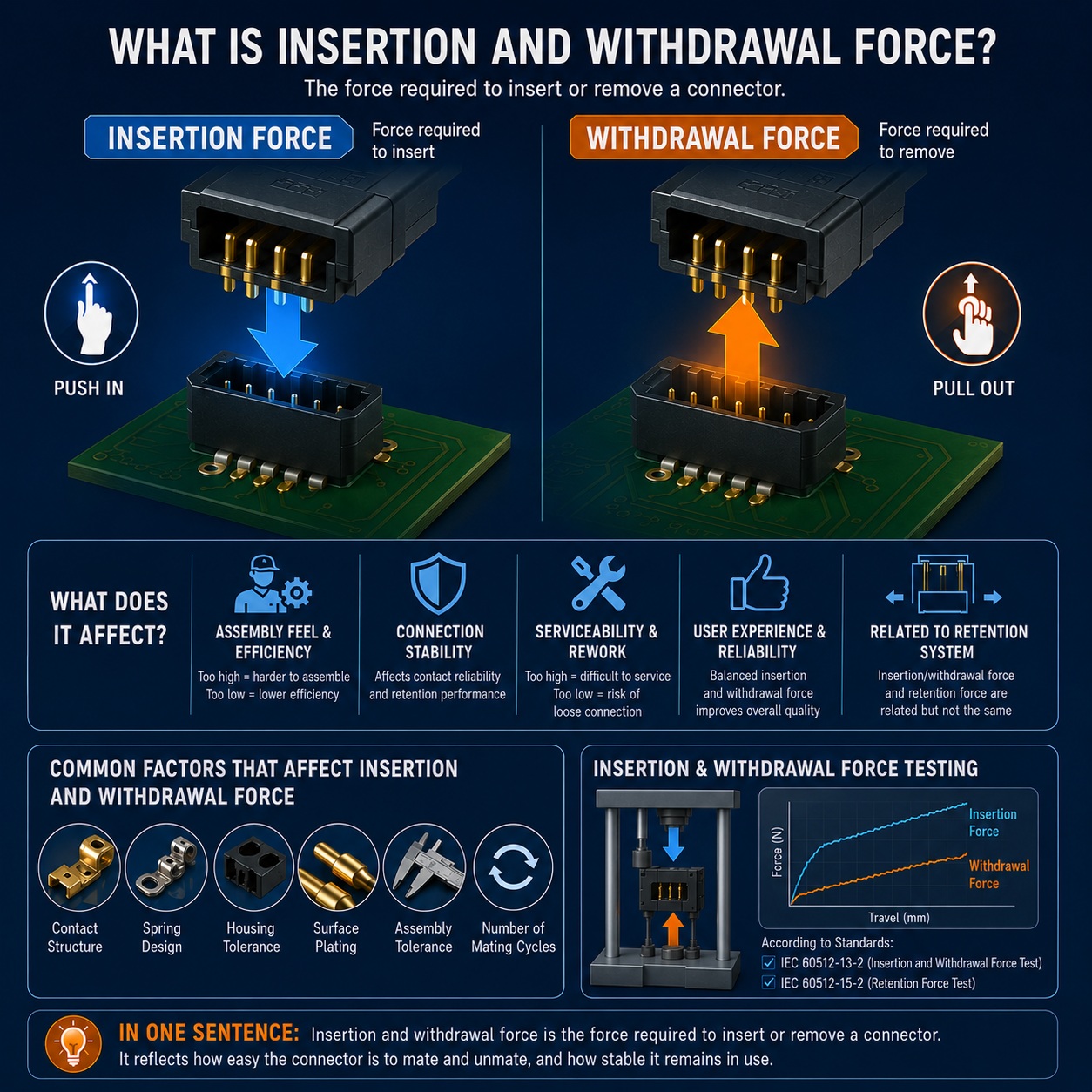
refers to the amount of force required to insert a connector and remove it from its mating counterpart. IEC 60512-13-2 defines this type of test as insertion
and withdrawal forces, which are used to measure how much force is needed
when two mating connectors are engaged or separated under specified test
conditions. In simple terms, insertion and withdrawal force is an important
indicator of how easy a connector is to mate, how easy it is to disconnect, and
how smooth the overall mating experience feels.
To break it down more precisely, insertion
force is the force required to push the connector into place, while withdrawal
force is the force required to separate or pull it out. In Chinese, “插拔力” is often used as
the general term because it is the most natural and searchable way to describe
both directions together. This usage is also consistent with IEC standards,
which treat insertion and withdrawal force as a paired mechanical test.
What Does Insertion and Withdrawal Force
Affect?
1. Assembly feel and production
efficiency
If the force is too high, assembly becomes harder and takes more time. If it is
too low, the connection may not feel stable enough. In mass-production
environments, the ideal design is usually one that is easy to assemble, easy to
disconnect, but still secure in use.
2. Connection stability
A connector must do more than simply fit together physically. It also needs to
maintain stable contact during normal use. IEC 60512-15-2 separately tests the
retaining system of a connector insert to confirm that it will not easily pull
out of the housing under normal axial force. This shows that insertion and
withdrawal force is related to, but not exactly the same as, retention
performance.
3. Ease of maintenance and rework
If the force is too high, disassembly, maintenance, or part replacement becomes
more difficult. If it is too low, contact stability may suffer. In practice,
engineers usually balance insertion force, withdrawal force, and retention
design to achieve the right trade-off.
Simple Way to Understand It
Insertion and withdrawal force is the
force required to plug in and unplug a connector.
It reflects how easy a connector is to use, how easy it is to remove, and how
stable it is during operation.
Common Factors That Affect Insertion and
Withdrawal Force
These include the contact design, spring
structure, housing fit, surface plating, manufacturing tolerances, and the
number of mating cycles. Because of these factors, different connectors can
have very different force specifications.
Summary
Insertion and withdrawal force is one of the most important mechanical performance indicators for connectors. It affects not only the user’s handling experience, but also assembly efficiency, connection stability, maintenance convenience, and long-term product reliability. For electronics, wire harnesses, industrial equipment, and high-speed transmission applications, the right force balance is essential for both usability and performance.
Need Wire Harnesses, Connectors, Electromechanical Components, or Custom Solutions? Contact Us Today
Whether you are looking for connectors, cables, wire harness assemblies, electromechanical components, or complete electronic interconnect solutions, SyncTronics provides professional technical support and engineering evaluation for product selection, specification verification, New Product Introduction (NPI), OEM/ODM customization, as well as high-speed transmission, high-reliability, and other specialized application requirements.
We welcome you to visit our Contact Us page and share your project requirements and contact information. Our team is committed to responding quickly and professionally, evaluating the most suitable products and electronic interconnect solutions based on your product specifications, application requirements, and project objectives. We also provide technical recommendations and customized engineering support to help shorten product selection and development time, reduce project risks, and accelerate your path to mass production. We look forward to the opportunity to work with you and provide reliable technical support and practical solutions for every stage of your project.
Related Articles:
Gold Plating Thickness Explained | SyncTronics Technology
Terminal vs Connector vs Header: Differences Explained | SyncTronics Technology
What Is Connector Pin Count? Complete Guide | SyncTronics Technology
SMT vs DIP Connectors: Complete Comparison | SyncTronics Technology
What Is Retention Force? Complete Guide | SyncTronics Technology
Disclaimer and Technical Exchange
Statement
This content is compiled based on publicly
available information and industry experience, intended solely for reference
during technical exchanges. It does not constitute any commercial, technical,
or legal advice or basis.
The specifications, materials, manufacturing processes, application methods,
and related information described herein may vary due to differing design
conditions, environmental factors, or usage scenarios. No guarantees are made
regarding the completeness, correctness, or suitability of such content.
Readers should verify the suitability with the responsible design or technical
personnel based on actual application scenarios, and independently assess all
associated risks.
Frequently Asked Questions (FAQ)
- What is Connector Knowledge
- What Is a Connector?
- Euro-Style vs. Barrier Terminal Blocks
- Ring vs. Fork Terminals: Differences
- What Is an IDC Connector?
- Box Header vs. Ejector Header: Latching, Ejection, and When to Use Each
- What Is a Box Header?
- 6 Common Connector Selection Mistakes and How to Avoid Them
- How to Select a USB Type-C Connector: Mating Cycles, Current Rating & PCB Mounting
- How to Select Industrial Automation Connectors: Locking, Vibration Resistance & Retention
- How to Select Energy Storage Connectors: Current Rating, Contact Resistance & Keying
- Why Do High-Current Connectors Overheat? Contact Resistance, Terminals & Crimp Quality
- What Is a Terminal Block? Types, Structure & Selection
- Wire-to-Board vs. Board-to-Board Connectors: Structure and Selection
- How to Select Drone Connectors and Wire Harnesses: Power, Flight Controller, GPS and Signal Connections
- What Connectors Are Commonly Used in Drones? XT30, XT60, JST-GH, and DF13 Explained
- How to Select Drone Battery Connectors: XT30, XT60 and XT90
- Why Do Drone Connectors Become Loose? Vibration Resistance, Polarization and Retention Design
- RJ45 Connector Structure and Applications Guide
- What Is Connector Pitch?
- What Does Connector Pin Count Mean?
- What Is the Difference Between a Terminal, a Connector, and a Coupling?
- What Is Contact Resistance, and What Does It Affect?
- What Is Connector Insertion and Withdrawal Force?
- What Is Retention Force?
- What Is Poka-Yoke (Error-Proofing) Design?
- What Is Gold Plating Thickness? Why Does It Affect Connector Lifespan?
- What Is the Difference Between SMT Connectors and DIP Connectors?
- Wire Related issues
- Materials-Related
- Regulatory Issues
- Electronic issues
- Manufacturing Technology
- Testing & Verification
- Quality Management
- History & Evolution