
What Is an 8D Report?
What Is an 8D Report? A Complete Guide to Customer Complaint Analysis and Corrective Action
An 8D Report (Eight Disciplines Problem Solving) is a structured problem-solving methodology widely used to investigate customer complaints, product defects, manufacturing issues, and quality problems.
An 8D Report is much more than a document—it is a systematic team-based approach for identifying root causes, implementing corrective actions, verifying their effectiveness, and preventing similar issues from occurring again.
Today, 8D Reports are commonly used in the automotive, electronics, semiconductor, industrial equipment, medical device, and aerospace industries.
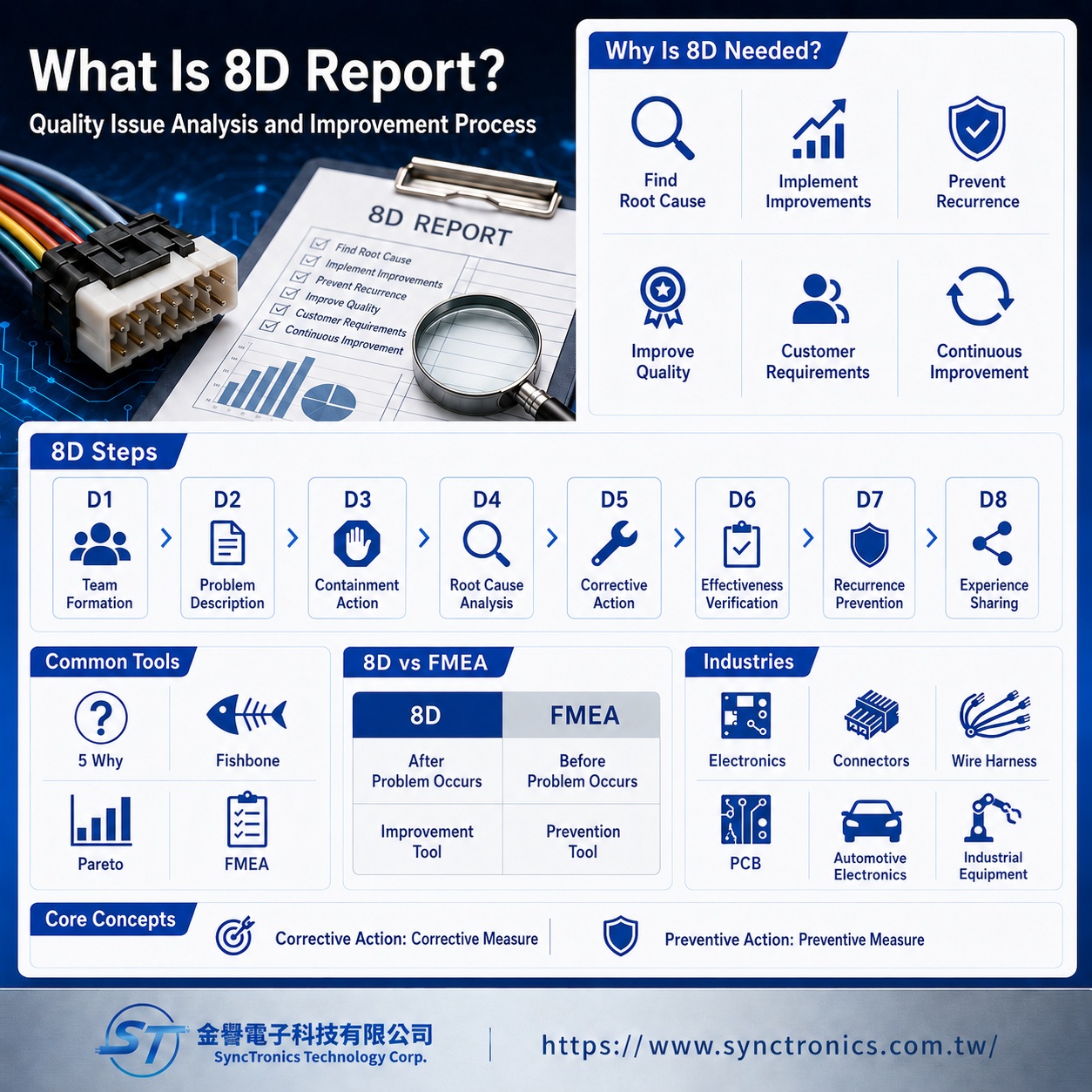
Why Is an 8D Report Important?
Simply fixing the immediate symptom of a quality issue often results in the same problem recurring.
An effective 8D process helps organizations:
- Identify the true root cause
- Implement effective corrective actions
- Prevent recurring problems
- Improve product quality
- Increase customer satisfaction
- Build a culture of continuous improvement
For this reason, many international customers require suppliers to submit a complete 8D Report when quality issues occur.
The Eight Disciplines (8D) Process
The standard 8D methodology consists of eight steps:
|
Step |
Description |
|
D1 |
Establish the problem-solving team |
|
D2 |
Describe the problem clearly |
|
D3 |
Implement containment actions |
|
D4 |
Identify the root cause |
|
D5 |
Develop permanent corrective actions |
|
D6 |
Verify the effectiveness of corrective actions |
|
D7 |
Prevent recurrence through system improvements |
|
D8 |
Recognize the team's contributions and document lessons learned |
Following all eight disciplines helps organizations resolve problems systematically and effectively.
Common Tools Used in 8D Reports
Various quality management tools are commonly used during the 8D process, including:
- 5 Why Analysis
- Fishbone Diagram (Ishikawa Diagram)
- Pareto Chart
- FMEA (Failure Mode and Effects Analysis)
- SPC (Statistical Process Control)
- Control Plan
These tools help teams identify root causes and develop more effective corrective actions.
What Is Root Cause Analysis?
Root Cause Analysis (RCA) is one of the most critical steps within the 8D process.
Instead of asking only "What happened?", RCA seeks to answer:
- Why did the problem occur?
- Why wasn't it detected?
- How can it be prevented from happening again?
Only by identifying the true root cause can permanent corrective actions be implemented successfully.
What Is the Difference Between Corrective Action and Preventive Action?
Two types of improvement actions are commonly included in an 8D Report.
|
Type |
Description |
|
Corrective Action |
Eliminates the cause of an existing problem |
|
Preventive Action |
Prevents similar problems from occurring in the future |
Together, they establish an effective continuous improvement system.
Which Industries Use 8D Reports?
8D Reports are widely used in:
- Electronics manufacturing
- Connector manufacturing
- Cable and wire harness assembly
- PCB assembly
- Automotive electronics
- AI servers
- Semiconductor manufacturing
- Industrial equipment
- Medical devices
- Aerospace
Any industry focused on product quality and customer satisfaction can benefit from the 8D methodology.
What Is the Difference Between an 8D Report and FMEA?
Although both are quality management tools, they serve different purposes.
|
Item |
8D Report |
FMEA |
|
Timing |
After a problem occurs |
Before a problem occurs |
|
Objective |
Solve existing quality issues |
Prevent potential failures |
|
Purpose |
Corrective improvement |
Preventive risk analysis |
In short, FMEA focuses on prevention, while 8D Reports focus on solving problems that have already occurred.
Benefits of Implementing 8D Reports
An effective 8D process helps organizations:
- Resolve customer complaints efficiently
- Improve root cause analysis capabilities
- Reduce recurring defects
- Enhance product quality
- Standardize problem-solving procedures
- Strengthen customer confidence
As a result, the 8D methodology has become one of the most widely used quality improvement tools in global manufacturing.
Conclusion
The 8D Report (Eight Disciplines Problem Solving) is a comprehensive methodology for investigating customer complaints and quality issues through structured teamwork, root cause analysis, corrective actions, and preventive measures. By following the eight disciplines, manufacturers can reduce recurring failures, improve product quality, enhance customer satisfaction, and establish a strong culture of continuous improvement. It is an essential quality management tool for electronics manufacturing, connectors, wire harnesses, AI servers, industrial equipment, and many other industries.
SyncTronics Solutions
SyncTronics Technology provides connector and cable application solutions that support high-mix, low-volume production as well as diverse application requirements. Based on customer application requirements, we assist in evaluating suitable connectors, cables, and product specifications while supporting product quality management, problem analysis, reliability improvement, and continuous quality enhancement. Our solutions help industrial equipment manufacturers, telecommunications companies, AI server providers, and other electronics industries establish practical quality management processes that improve product consistency and long-term reliability.
Need Wire Harnesses, Connectors, Electromechanical Components, or Custom Solutions? Contact Us Today
Whether you are looking for connectors,
cables, wire harness assemblies, electromechanical components, or complete
electronic interconnect solutions, SyncTronics provides professional technical
support and engineering evaluation for product selection, specification
verification, New Product Introduction (NPI), OEM/ODM customization, as well as
high-speed transmission, high-reliability, and other specialized application
requirements.
We welcome you to visit our Contact Us page
and share your project requirements and contact information. Our team is
committed to responding quickly and professionally, evaluating the most
suitable products and electronic interconnect solutions based on your product
specifications, application requirements, and project objectives. We also
provide technical recommendations and customized engineering support to help
shorten product selection and development time, reduce project risks, and
accelerate your path to mass production. We look forward to the opportunity to
work with you and provide reliable technical support and practical solutions
for every stage of your project.
Related Articles:
Disclaimer and Technical Exchange
Statement
This content is compiled based on publicly available information and industry
experience, intended solely for reference during technical exchanges. It does
not constitute any commercial, technical, or legal advice or basis.
The specifications, materials, manufacturing processes, application methods,
and related information described herein may vary due to differing design
conditions, environmental factors, or usage scenarios. No guarantees are made
regarding the completeness, correctness, or suitability of such content.
Readers should verify the suitability with the responsible design or technical
personnel based on actual application scenarios, and independently assess all
associated risks.
Frequently Asked Questions (FAQ)
- What is Connector Knowledge
- Wire Related issues
- Materials-Related
- Regulatory Issues
- Electronic issues
- Manufacturing Technology
- Testing & Verification
- Quality Management
- MOQ vs. MPQ vs. SPQ
- What Is NCNR?
- What Is an LOA (Letter of Authorization)?
- ECR vs. ECN: How the Engineering Change Process Works
- How Is Material Traceability Managed for Energy Storage Wire Harnesses? Lot, Wire & Terminal Control
- What Is PPAP? A Complete Guide to the Production Part Approval Process
- What Are EOL and PCN?
- What Is Incoming Quality Control (IQC)?
- What Is In-Process Quality Control (IPQC)?
- What Is Outgoing Quality Control (OQC)?
- What Is AQL (Acceptable Quality Level)?
- What Are CoC and CoA?
- What Is Material Traceability?
- What Is a Date Code (D/C)?
- What Are LOT Numbers and BIN Codes?
- What Is FMEA (Failure Mode and Effects Analysis)?
- What Is an 8D Report?
- What Is Six Sigma?
- What Are Cp and Cpk?
- What Is a Control Plan?
- What Is ISO 9001?
- What Is IATF 16949?
- History & Evolution