
What Is FCC Certification? A Complete Guide to U.S. Electronic Product Compliance
What Is FCC Certification? A Complete Guide to U.S. Electronic Product Compliance
FCC stands for the Federal Communications Commission, the U.S. agency responsible for regulating interstate and international communications and radio-frequency equipment.
Many electronic products must comply with FCC requirements before they can be legally marketed in the United States. These rules are intended to control radio-frequency emissions and reduce the risk of harmful interference with authorized radio services.
The industry commonly uses the term “FCC certification” as a general expression. However, under the FCC Equipment Authorization framework, products may follow different compliance procedures depending on their functions and applicable FCC rules.
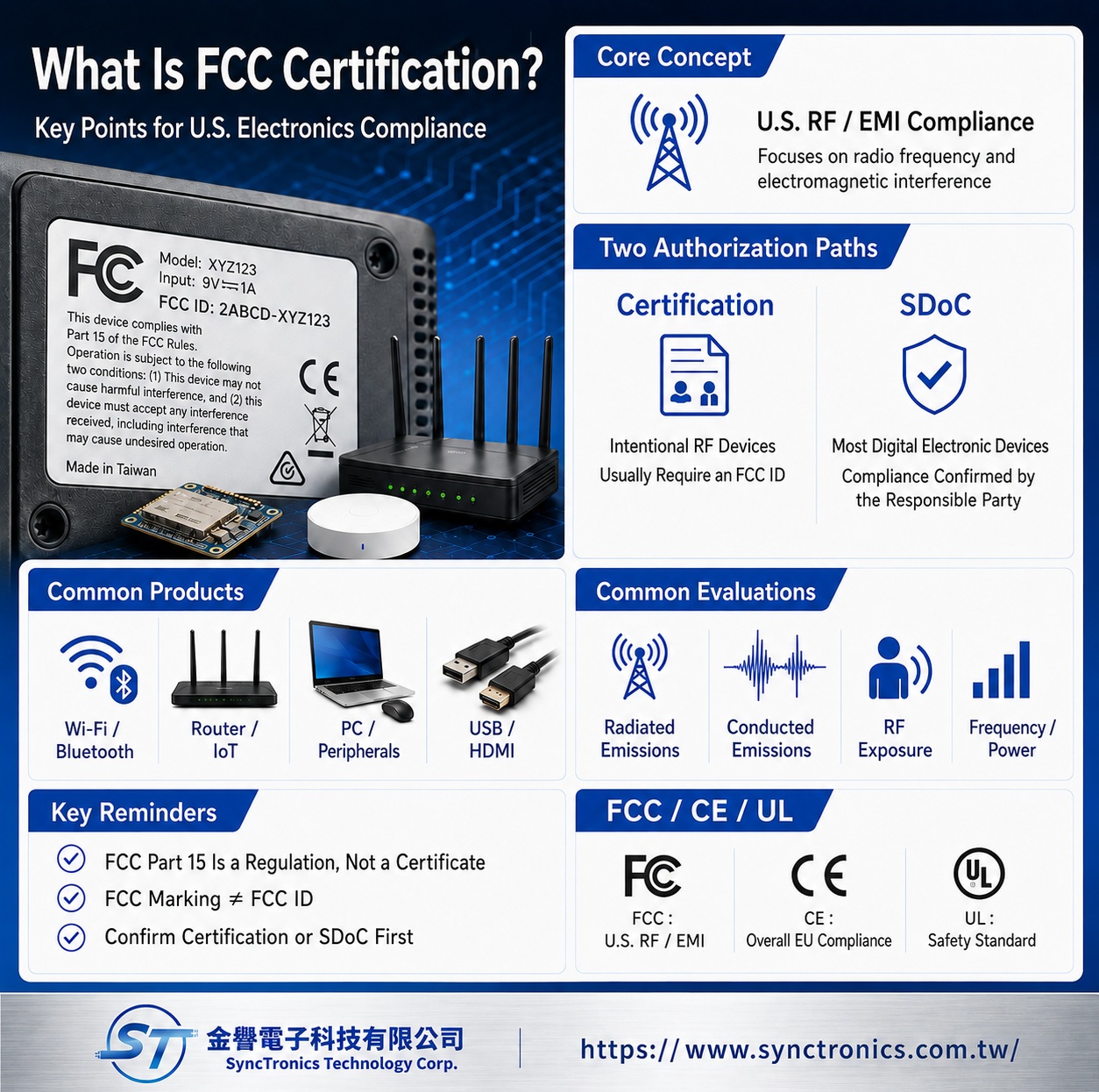
The two primary equipment authorization procedures are Certification and Supplier’s Declaration of Conformity (SDoC).
What Types of Electronic Products May Require FCC Compliance?
Products that generate, use or intentionally transmit radio-frequency energy may fall within FCC requirements.
Common examples include:
- Wi-Fi and Bluetooth devices
- Zigbee and other wireless communication products
- Wireless remote controls
- RF transmitters
- Routers and networking equipment
- Computers and peripheral devices
- Displays and digital electronic equipment
- Electronic products containing USB or HDMI high-speed digital circuits
- Wireless charging devices
- Industrial control and communication equipment
- IoT and smart-home products
However, whether a product requires Certification, SDoC or qualifies for a particular exemption cannot be determined from the product name alone.
The actual regulatory pathway depends on factors such as circuit function, operating frequency, transmission method and intended application.
What Is the Difference Between FCC Certification and SDoC?
The current FCC equipment authorization framework primarily uses Certification and Supplier’s Declaration of Conformity.
|
Authorization Method |
Certification |
SDoC |
|
Full Name |
FCC Certification |
Supplier’s Declaration of Conformity |
|
Common Applications |
Many intentional RF transmitters |
Many non-transmitting digital electronic devices |
|
TCB Application |
Generally required |
Generally not required |
|
Testing |
Must demonstrate compliance with applicable FCC requirements |
Compliance must be demonstrated under applicable FCC technical requirements |
|
FCC ID |
Generally required for Certification equipment |
Normally not used as the authorization method |
|
Core Purpose |
Formal authorization for regulated RF equipment |
Responsible party declares product compliance |
Certification is generally used for equipment with greater potential to create radio-frequency interference, especially intentional transmitters.
Certification applications are typically reviewed by an FCC-recognized Telecommunications Certification Body (TCB) based on test reports and technical documentation.
SDoC allows the responsible party to demonstrate that the product complies with applicable FCC requirements without following the same TCB Certification application process.
What Is an Intentional Radiator?
An Intentional Radiator is a device intentionally designed to generate and emit radio-frequency energy.
Common examples include:
- Wi-Fi devices
- Bluetooth devices
- Zigbee products
- Wireless remote controls
- Wireless data transmitters
- Certain IoT wireless modules
These devices commonly require Certification under the applicable FCC rules.
For example, if a product includes a 2.4 GHz Bluetooth function, the wireless portion must be evaluated for the appropriate FCC authorization even if Bluetooth represents only a small part of the complete product.
What Is an Unintentional Radiator?
An Unintentional Radiator is a device that generates radio-frequency energy internally but is not intentionally designed to transmit RF energy by radiation or induction.
Electronic equipment containing processors, clocks and high-speed digital circuits can generate unintended electromagnetic emissions.
Under FCC Part 15 requirements, many unintentional radiators must follow SDoC or Certification depending on the device category.
General digital devices and peripherals can often use SDoC, while certain specific equipment categories may still require Certification.
What Is FCC Part 15?
FCC Part 15 is one of the most commonly encountered FCC regulatory sections in the electronics industry.
It covers many unlicensed radio-frequency devices, including both Intentional Radiators and Unintentional Radiators.
A key point is:
FCC Part 15 is not the name of a single FCC certificate. It is a set of regulatory requirements.
A product may comply with Part 15 while following either Certification or SDoC as its equipment authorization procedure.
This distinction is important because purchasing, engineering and compliance teams sometimes incorrectly assume that “Part 15 compliant” automatically means that a product has an FCC Certification certificate.
What Does FCC Testing Commonly Cover?
Actual test requirements depend on the product type and applicable FCC rules.
Common evaluation items may include:
- Radiated emissions
- Conducted emissions
- Operating frequency
- RF output power
- Spectrum characteristics
- Out-of-band emissions
- Spurious emissions
- Antenna-related conditions
- RF exposure
Non-wireless digital products generally focus more heavily on unintended electromagnetic emissions.
Products incorporating Wi-Fi, Bluetooth or other wireless technologies may require additional evaluation of transmitter frequency, output power and RF characteristics.
Because intentional and unintentional radiators are subject to different technical requirements, a test plan should be established according to the actual product design rather than applying the same procedure to every electronic product.
What Is an FCC ID?
Devices authorized through FCC Certification are normally assigned an FCC ID.
The FCC ID identifies the authorized equipment and the applicant and can be used to locate authorization information through FCC databases.
However, the presence of an FCC-related statement does not automatically mean that a product has an FCC ID.
Products authorized through SDoC follow a different compliance pathway.
When reviewing a product or supplier document, it is important to verify:
- Whether the product uses Certification or SDoC
- Whether the FCC ID corresponds to the actual product
- Whether the installed wireless module has valid authorization
- Whether host-product integration remains within the conditions of the module authorization
Does Using a Pre-Certified Wireless Module Eliminate FCC Testing for the Final Product?
Not necessarily.
Using a Wi-Fi or Bluetooth module that already has FCC Certification may reduce some testing and certification work, but the final product must still comply with the conditions under which the module was authorized.
Important factors can include:
- Antenna type
- Antenna gain
- Installation distance
- RF exposure requirements
- Host-device configuration
- Whether the module is fully modular or limited modular approved
- Whether the final application remains within the original authorization conditions
Therefore, the common assumption that “the module has an FCC ID, so the complete product automatically complies with FCC requirements” is not always correct.
Host-product integration requirements must still be evaluated.
What Should Be Considered for FCC Labeling?
Different equipment authorization procedures may have different labeling and user-information requirements.
Depending on the product and applicable FCC rules, requirements may involve:
- FCC ID
- Product identification
- Compliance statements
- Product labels
- Packaging information
- User manual notices
- Responsible party information
- Wireless module integration statements
For products too small for conventional physical labeling, alternative approaches such as electronic labeling or documentation may be permitted under applicable rules.
Compliance work therefore extends beyond laboratory testing. Product labels, manuals, packaging and regulatory documentation should also be reviewed before market launch.
What Is the Difference Between FCC, CE and UL?
|
Item |
FCC |
CE |
UL |
|
Primary Market |
United States |
European Union / EEA-related markets |
Primarily North America |
|
Main Focus |
RF and electromagnetic interference |
Compliance with applicable EU legislation |
Product safety and related standards |
|
Are They Equivalent? |
No |
No |
No |
Passing CE requirements does not automatically mean that a product complies with FCC requirements.
Likewise, obtaining FCC equipment authorization does not mean that a product automatically satisfies every U.S. requirement related to electrical safety, energy efficiency, hazardous substances or other regulations.
Products intended for multiple markets should therefore establish a complete compliance matrix based on product functionality and destination markets rather than relying on a single certification.
Common FCC Compliance Misunderstandings
Every electronic product requires an FCC ID
Not necessarily. FCC IDs are mainly associated with Certification equipment. Many other products follow SDoC.
Products without Wi-Fi do not require FCC compliance
Not necessarily. Digital electronic devices without wireless transmitters may still qualify as unintentional radiators.
A wireless module with an FCC ID means the complete product requires no further evaluation
The final host product must still comply with module integration conditions and any other applicable FCC requirements.
FCC and CE testing are interchangeable
No. They apply to different markets and regulatory frameworks and cannot automatically replace one another.
Conclusion
The term “FCC certification” is commonly used to describe U.S. regulatory compliance for radio-frequency equipment and electronic products that may create electromagnetic interference.
Under the current FCC Equipment Authorization framework, the two primary compliance procedures are Certification and Supplier’s Declaration of Conformity (SDoC).
Products that intentionally transmit Wi-Fi, Bluetooth or other RF signals are more likely to require Certification, while many general digital electronic devices may follow SDoC depending on the applicable FCC rules.
Before launching a product in the United States, companies should identify the equipment category, operating frequency, wireless functions, applicable FCC Rule Part and authorization procedure before arranging testing, documentation, labeling and related compliance work.
SyncTronics Solutions
SyncTronics Technology supports customers with product specification review, material information and supply chain documentation for electronic products, connectors, cables, wire harnesses and related components.
For projects involving FCC, CE, RoHS, REACH, UL and other regulatory requirements, we can assist with organizing relevant component specifications, test documentation and supply chain information.
For OEM/ODM, New Product Introduction (NPI), high-mix low-volume and special-requirement projects, SyncTronics can also support electronic interconnect component selection, supply chain information integration and related technical coordination.
Actual FCC equipment authorization, testing and regulatory classification should be confirmed by qualified laboratories, Telecommunications Certification Bodies (TCBs) or relevant compliance professionals according to the actual product design.
Need Wire Harnesses, Connectors, Electromechanical Components, or Custom Solutions? Contact Us Today
Whether you are looking for connectors, cables, wire harness assemblies, electromechanical components, or complete electronic interconnect solutions, SyncTronics provides professional technical support and engineering evaluation for product selection, specification verification, New Product Introduction (NPI), OEM/ODM customization, as well as high-speed transmission, high-reliability, and other specialized application requirements.
We welcome you to visit our Contact Us page and share your project requirements and contact information. Our team is committed to responding quickly and professionally, evaluating the most suitable products and electronic interconnect solutions based on your product specifications, application requirements, and project objectives. We also provide technical recommendations and customized engineering support to help shorten product selection and development time, reduce project risks, and accelerate your path to mass production. We look forward to the opportunity to work with you and provide reliable technical support and practical solutions for every stage of your project.
Related Articles
CE Marking Guide: Essential Requirements for Europe | SyncTronics
What Is EMC? Electromagnetic Compatibility Explained | SyncTronics Technology
What Is RED Directive? Radio Equipment Regulation Explained | SyncTronics Technology
What Are RoHS, REACH, and WEEE? Key EU Compliance Differences | SyncTronics Technology
Disclaimer and Technical Exchange Statement
This content is compiled based on publicly available information and industry experience, intended solely for reference during technical exchanges. It does not constitute any commercial, technical, or legal advice or basis.
The specifications, materials, manufacturing processes, application methods, and related information described herein may vary due to differing design conditions, environmental factors, or usage scenarios. No guarantees are made regarding the completeness, correctness, or suitability of such content.
Readers should verify the suitability with the responsible design or technical personnel based on actual application scenarios, and independently assess all associated risks.
Frequently Asked Questions (FAQ)
- What is Connector Knowledge
- Wire Related issues
- Materials-Related
- Regulatory Issues
- What Is EU Machinery Regulation 2023/1230? Automation Equipment & Electrical Safety Requirements Explained
- What EU Cable Regulations Apply? RoHS, REACH, CPR & Material Compliance Explained
- What Is FCC Certification? A Complete Guide to U.S. Electronic Product Compliance
- What Is UL94? A Complete Guide to Flammability Ratings and Plastic Fire Resistance Standards
- What Are Conflict Minerals?
- What Is IP Rating?
- What Is UL Certification?
- What Is UL Fire Rating?
- What Is the LVD Directive?
- What Is EMC?
- What Is RoHS 2.0?
- What Is the RED Directive?
- What Are RoHS, REACH, and WEEE? Key Differences Explained
- What Is the REACH Regulation? A Complete Guide to EU Chemical Compliance
- What Is the WEEE Directive? What Are the Regulations for Electronic Waste Recycling?
- What Are CMRT and EMRT?
- What Is Halogen Free (HF)?
- What Is California Proposition 65?
- What Is CE Certification? The Key Compliance Requirement for Electronic Products Entering the European Market
- Electronic issues
- Manufacturing Technology
- Testing & Verification
- Quality Management
- History & Evolution