
What Is UL94? A Complete Guide to Flammability Ratings and Plastic Fire Resistance Standards
UL94 is one of the world's most widely recognized flammability testing standards for plastic materials used in electrical and electronic products. It evaluates how a material reacts when exposed to an open flame, including its burning rate, self-extinguishing capability, and whether burning droplets are produced. Many connectors, cable assemblies, electronic components, and industrial equipment require UL94-rated materials to improve product safety and meet international compliance requirements.
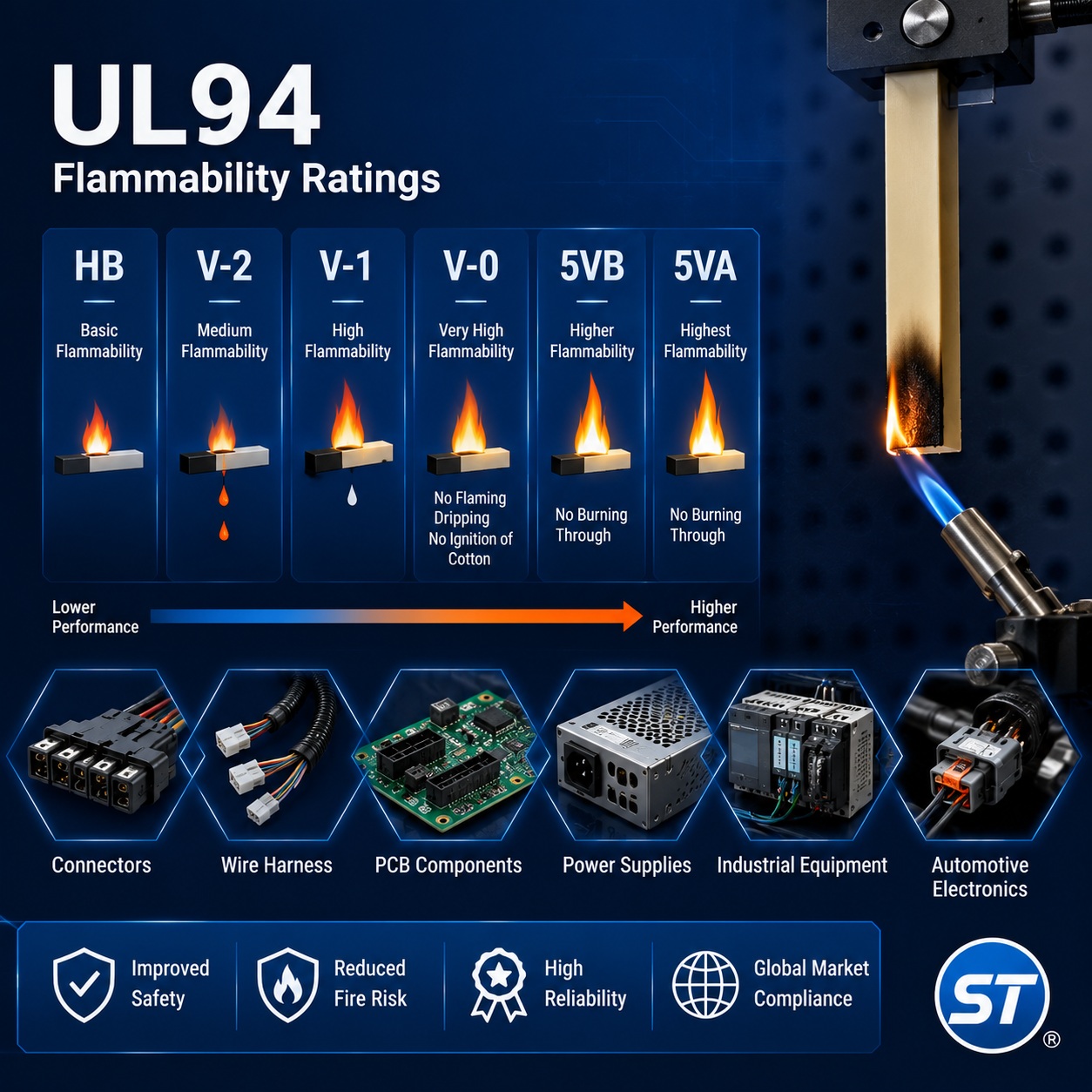
What Is UL94?
UL94 is a flammability standard developed by Underwriters Laboratories (UL) to evaluate the fire resistance of plastic materials.
Unlike a product certification, UL94 specifically tests the flammability performance of plastic materials. It is commonly applied to:
- Electronic connectors
- Wire and cable assemblies
- PCB insulating materials
- Power supplies
- Industrial equipment
- Consumer electronics
- Automotive electronic components
Why Is UL94 Important?
Electronic devices may generate heat due to short circuits, overloads, or electrical failures.
Without adequate flame-retardant properties, plastic materials may ignite and allow fire to spread rapidly, increasing safety risks and equipment damage.
Using UL94-rated materials offers several advantages:
- Improved product safety
- Reduced fire hazards
- Enhanced product reliability
- Compliance with international industry requirements
- Easier access to global markets
Common UL94 Flammability Ratings
UL94 classifies materials using horizontal and vertical burning tests.
|
Rating |
Flame Resistance |
Characteristics |
|
HB |
Basic |
Meets horizontal burning requirements |
|
V-2 |
Moderate |
Self-extinguishing, burning drips permitted |
|
V-1 |
High |
Faster self-extinguishing, no flaming drips that ignite cotton |
|
V-0 |
Very High |
Fastest self-extinguishing, no flaming drips that ignite cotton |
|
5VB |
Higher |
Withstands larger flame exposure without burn-through |
|
5VA |
Highest |
Highest flame resistance with no burn-through |
Among these ratings, UL94 V-0 is the most commonly specified requirement for electronic connectors and electrical components.
What Is the Difference Between V-0, V-1, and V-2?
|
Feature |
V-0 |
V-1 |
V-2 |
|
Self-extinguishing time |
Shortest |
Short |
Longer |
|
Burning drips |
Not allowed to ignite cotton |
Not allowed to ignite cotton |
Burning drips permitted |
|
Flame resistance |
Highest among V ratings |
High |
Moderate |
|
Typical applications |
Connectors, industrial equipment, automotive electronics |
General electronics |
Consumer electronic products |
For products requiring higher safety and reliability, UL94 V-0 is generally the preferred choice.
How Is UL94 Tested?
In the vertical burning test, the typical procedure includes:
- Mount the plastic specimen vertically.
- Apply a standardized flame for a specified period.
- Remove the flame.
- Measure the self-extinguishing time.
- Observe whether burning droplets are produced.
- Determine the appropriate UL94 classification.
Each rating has specific requirements regarding burning duration, dripping behavior, and cotton ignition.
Which Materials Can Achieve UL94 V-0?
Many engineering plastics used in electronics can achieve UL94 V-0 when formulated appropriately.
|
Material |
Typical Rating |
Common Applications |
|
LCP |
V-0 |
High-speed connectors, precision connectors |
|
PA66 (Flame-Retardant Grade) |
V-0 |
Wire harnesses, terminals, industrial connectors |
|
PBT (Flame-Retardant Grade) |
V-0 |
PCB connectors, consumer electronics |
|
PPS |
V-0 |
Automotive electronics, high-temperature applications |
|
High-Performance Engineering Plastics |
V-0 or higher |
Industrial, aerospace, medical equipment |
The final rating depends on material formulation, thickness, and testing conditions.
UL94 vs. UL Certification
Many people confuse UL94 with UL Certification, but they serve different purposes.
|
Item |
UL94 |
UL Certification |
|
Scope |
Plastic material |
Finished product or component |
|
Purpose |
Flammability testing |
Product safety certification |
|
Applies To |
Plastic materials |
Electrical and electronic products |
|
Equivalent |
No |
No |
A material with a UL94 V-0 rating does not automatically mean the finished product is UL Certified. However, UL94-rated materials are often required when applying for UL product certification.
Typical Applications
UL94 flame-retardant materials are widely used in:
- Board-to-board connectors
- USB, HDMI, and RJ45 connectors
- Wire harnesses and cable assemblies
- PCB insulating components
- Power supplies
- Industrial control equipment
- Automotive electronics
- Communication systems
- Medical electronic devices
Frequently Asked Questions (FAQ)
Is UL94 V-0 the highest rating?
No. UL94 also includes higher classifications such as 5VB and 5VA. However, V-0 is the most widely used rating in the electronics industry.
Can every plastic material achieve UL94 V-0?
Not necessarily. The rating depends on the material type, flame-retardant formulation, thickness, and actual laboratory test results.
Is UL94 related to RoHS?
No. UL94 evaluates flame resistance, while RoHS restricts hazardous substances. They address different compliance requirements, although many electronic products are expected to comply with both.
Why do many connectors require UL94 V-0 materials?
Connectors may experience elevated temperatures during operation. UL94 V-0 materials help reduce fire propagation risks, improving both safety and long-term reliability.
SyncTronics Solutions
SyncTronics Technology provides customized connector manufacturing, cable assembly, and precision metal component solutions. We support engineering plastics that comply with UL94 V-0 and other flame-retardant requirements, helping customers meet the safety and reliability standards required for industrial automation, communications, automotive electronics, and consumer electronic applications.
Summary
UL94 is one of the most important flammability standards for plastic materials used in the electronics industry. Understanding the differences between HB, V-2, V-1, V-0, 5VB, and 5VA enables engineers, designers, and procurement professionals to select materials that balance safety, reliability, regulatory compliance, and product performance.
Need Wire Harnesses, Connectors, Electromechanical Components, or Custom Solutions? Contact Us Today
Whether you are looking for connectors,
cables, wire harness assemblies, electromechanical components, or complete
electronic interconnect solutions, SyncTronics provides professional technical
support and engineering evaluation for product selection, specification
verification, New Product Introduction (NPI), OEM/ODM customization, as well as
high-speed transmission, high-reliability, and other specialized application
requirements.
We welcome you to visit our Contact Us page
and share your project requirements and contact information. Our team is
committed to responding quickly and professionally, evaluating the most
suitable products and electronic interconnect solutions based on your product
specifications, application requirements, and project objectives. We also
provide technical recommendations and customized engineering support to help
shorten product selection and development time, reduce project risks, and
accelerate your path to mass production. We look forward to the opportunity to
work with you and provide reliable technical support and practical solutions
for every stage of your project.
Related articles:
What Is UL Certification? Electronic Safety Standards Explained | SyncTronics Technology
What Are RoHS, REACH, and WEEE? Key EU Compliance Differences | SyncTronics Technology
What Are Conductive Materials? Types and Applications Explained | Electronics Materials Guide
What Is a High Temperature Cable? Materials, Features & Applications | SyncTronics Technology
Disclaimer and Technical Exchange Statement
This content is compiled based on publicly available information and industry experience, intended solely for reference during technical exchanges. It does not constitute any commercial, technical, or legal advice or basis.
The specifications, materials, manufacturing processes, application methods, and related information described herein may vary due to differing design conditions, environmental factors, or usage scenarios. No guarantees are made regarding the completeness, correctness, or suitability of such content.
Readers should verify the suitability with the responsible design or technical personnel based on actual application scenarios, and independently assess all associated risks.
Frequently Asked Questions (FAQ)
- What is Connector Knowledge
- Wire Related issues
- Materials-Related
- Regulatory Issues
- What Is EU Machinery Regulation 2023/1230? Automation Equipment & Electrical Safety Requirements Explained
- What EU Cable Regulations Apply? RoHS, REACH, CPR & Material Compliance Explained
- What Is FCC Certification? A Complete Guide to U.S. Electronic Product Compliance
- What Is UL94? A Complete Guide to Flammability Ratings and Plastic Fire Resistance Standards
- What Are Conflict Minerals?
- What Is IP Rating?
- What Is UL Certification?
- What Is UL Fire Rating?
- What Is the LVD Directive?
- What Is EMC?
- What Is RoHS 2.0?
- What Is the RED Directive?
- What Are RoHS, REACH, and WEEE? Key Differences Explained
- What Is the REACH Regulation? A Complete Guide to EU Chemical Compliance
- What Is the WEEE Directive? What Are the Regulations for Electronic Waste Recycling?
- What Are CMRT and EMRT?
- What Is Halogen Free (HF)?
- What Is California Proposition 65?
- What Is CE Certification? The Key Compliance Requirement for Electronic Products Entering the European Market
- Electronic issues
- Manufacturing Technology
- Testing & Verification
- Quality Management
- History & Evolution