
What Is Plating Thickness? How Does It Affect Product Quality and Service Life?
What Is Plating Thickness?
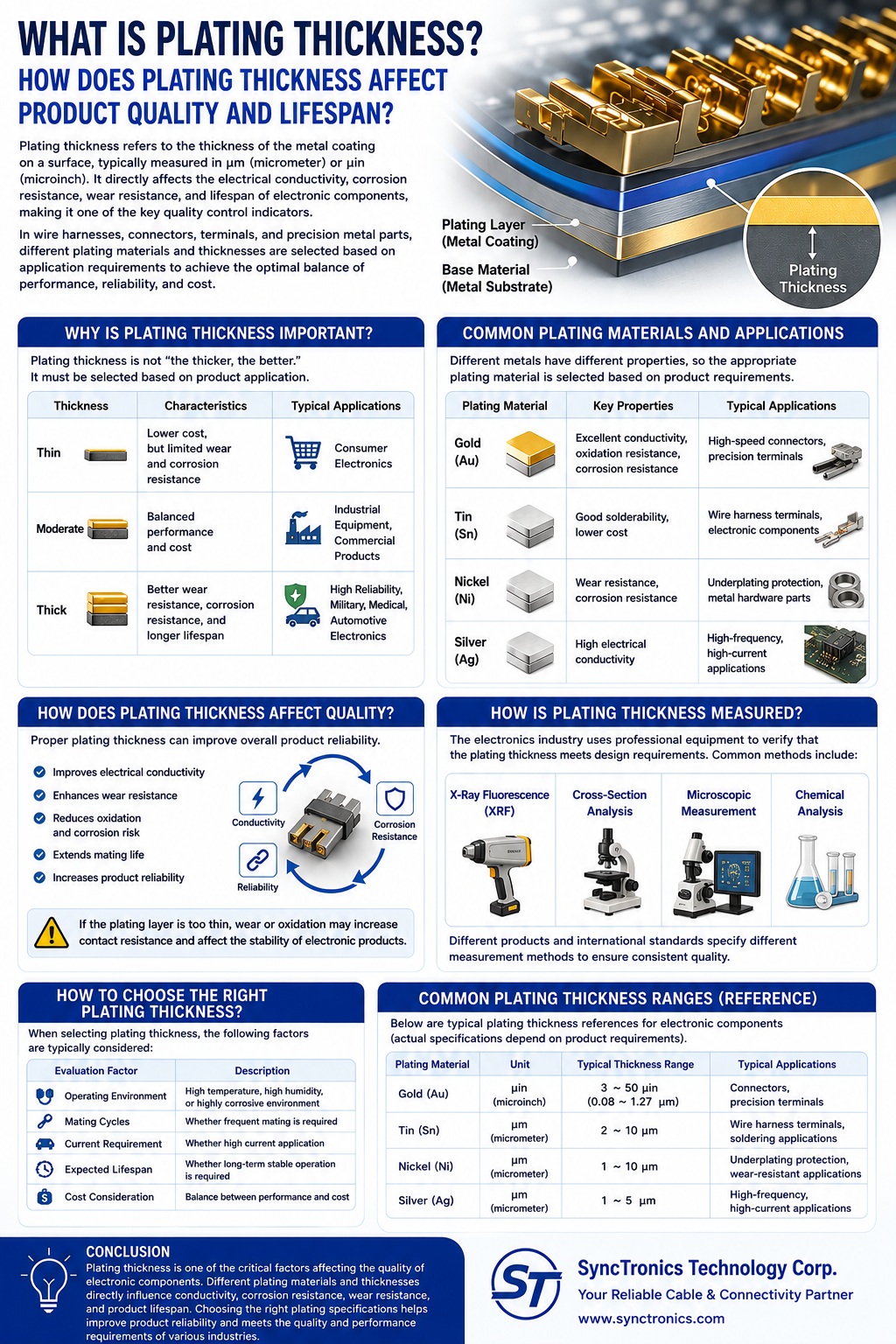
Plating thickness refers to the thickness of the metal coating applied to the surface of a component through electroplating or other surface finishing processes. It is commonly measured in micrometers (μm) or microinches (μin). The thickness of the plating directly affects electrical conductivity, corrosion resistance, wear resistance, and the overall service life of electronic components.
For products such as wire harnesses, connectors, terminals, and precision metal parts, selecting the appropriate plating material and thickness is essential for balancing performance, reliability, and manufacturing cost.
Why Is Plating Thickness Important?
Plating thickness is not simply "the thicker, the better." Instead, it should be selected according to the intended application.
|
Plating Thickness |
Characteristics |
Typical Applications |
|
Thin |
Lower cost but limited wear and corrosion resistance |
Consumer electronics |
|
Medium |
Balanced performance and cost |
Industrial and commercial equipment |
|
Thick |
Superior wear resistance, corrosion resistance, and durability |
Automotive, medical, aerospace, and high-reliability electronics |
Common Plating Materials and Their Applications
Different plating materials provide different performance characteristics.
|
Plating Material |
Key Characteristics |
Typical Applications |
|
Gold |
Excellent conductivity, oxidation resistance, corrosion resistance |
High-speed connectors, precision terminals |
|
Tin |
Excellent solderability and cost-effective |
Wire harness terminals, electronic components |
|
Nickel |
High hardness, wear resistance, corrosion protection |
Underplating, precision metal parts |
|
Silver |
Extremely high electrical conductivity |
High-frequency and high-current applications |
How Does Plating Thickness Affect Product Performance?
Selecting an appropriate plating thickness can significantly improve product reliability.
- Improves electrical conductivity
- Enhances wear resistance
- Reduces oxidation and corrosion
- Extends mating cycle life
- Improves long-term reliability
If the plating layer is too thin, wear or oxidation may increase contact resistance and reduce the stability of electrical connections.
How Is Plating Thickness Measured?
Manufacturers use specialized equipment to verify that plating thickness meets design specifications. Common inspection methods include:
- X-ray Fluorescence (XRF)
- Metallographic cross-section analysis
- Optical microscopy
- Chemical analysis
Different products and international standards specify different inspection methods depending on application requirements.
How to Select the Appropriate Plating Thickness
Several factors should be considered when selecting plating thickness.
|
Consideration |
Description |
|
Operating Environment |
High temperature, humidity, or corrosive conditions |
|
Mating Cycles |
Frequency of connector insertion and removal |
|
Current Capacity |
High-current or signal transmission requirements |
|
Product Lifetime |
Expected service life and reliability |
|
Cost Consideration |
Balance between performance and manufacturing cost |
Conclusion
Plating thickness is one of the key factors affecting the quality and reliability of electronic components. The combination of plating material and thickness directly influences conductivity, corrosion resistance, wear resistance, and product longevity. Selecting the appropriate plating specification helps manufacturers achieve better product performance while meeting industry reliability and quality requirements.
Need Wire Harnesses, Connectors,
Electromechanical Components, or Custom Solutions? Contact Us Today
Whether you are looking for connectors,
cables, wire harness assemblies, electromechanical components, or complete
electronic interconnect solutions, SyncTronics provides professional technical
support and engineering evaluation for product selection, specification
verification, New Product Introduction (NPI), OEM/ODM customization, as well as
high-speed transmission, high-reliability, and other specialized application
requirements.
We welcome you to visit our Contact Us page and
share your project requirements and contact information. Our team is committed
to responding quickly and professionally, evaluating the most suitable
products and electronic interconnect solutions based on your product
specifications, application requirements, and project objectives. We also
provide technical recommendations and customized engineering support to help
shorten product selection and development time, reduce project risks, and
accelerate your path to mass production. We look forward to the opportunity to
work with you and provide reliable technical support and practical solutions
for every stage of your project.
Related articles:
What Is Metal Surface Treatment? Complete Guide | SyncTronics Technology
Why Does Electroplating Price Vary So Much? MOQ, Thickness & Cost Explained | SyncTronics Technology
What Are Corrosion-Resistant Materials? Properties & Applications Explained | SyncTronics Technology
This content is compiled from publicly available information and industry insights for general informational purposes only. It is not intended to be, and should not be construed as, real-time or comprehensive information, and no representation or warranty is made regarding its accuracy, completeness, reliability, or suitability for any particular purpose. Nothing in this content constitutes legal, financial, investment, energy, or business advice. Any action taken based on this content is at the reader’s own risk. Readers are strongly encouraged to consult a qualified professional or attorney before making any decision. To the fullest extent permitted by applicable law, we disclaim liability for any direct or indirect loss or damage arising from the use of this content.
Frequently Asked Questions (FAQ)
- What is Connector Knowledge
- Wire Related issues
- Materials-Related
- What Is Thermoplastic (TP)? Terminal Block Materials & Selection Explained
- PVC vs. PUR Cable Jackets: Differences and Selection Guide
- What Is Beryllium Copper? Connector Terminal Material Properties and Applications
- What Is Phosphor Bronze? Connector Terminal Material Explained
- What Is Metal Surface Treatment? Complete Guide
- What Is Electroplating Grade? A Complete Guide to Plating Thickness and Quality Standards
- What Is Plating Thickness? How Does It Affect Product Quality and Service Life?
- What Are Gold, Tin, and Nickel Plating? Understanding the Differences Between Common Metal Plating Finishes
- Why Does Electroplating Price Vary So Much? Understanding MOQ, Plating Thickness, and Processing Costs
- What Are Corrosion-Resistant Materials? Complete Guide to Material Properties and Applications
- Common Connector Materials Explained: Applications of LCP, PBT, ABS, and Nylon 6T
- What Are LCP, PBT, ABS, and Nylon 6T? Material Comparison Guide
- What Are Halogen-Free Materials and Halogen-Free Processes? Complete Guide to Halogen Free (HF)
- What Is Halogen-Free Material? Complete Guide to Halogen-Free (HF) Materials
- What Is PPS Material? Complete Guide to Properties and Applications
- What Is PA66 Material? Complete Guide to Nylon 66 Properties and Applications
- What Are High-Temperature Engineering Plastics? Complete Guide to High-Performance Plastic Materials
- What Are Flame Retardant Materials? Complete Guide to Flame Ratings and Applications
- What Are Insulation Materials? Complete Guide to Electrical Insulation Materials
- What Are Conductive Materials? Complete Guide to Types and Applications
- What Are Rare Earth Elements? A Complete Guide to Industrial Raw Materials, Rare Metals, and Critical Minerals
- Regulatory Issues
- Electronic issues
- Manufacturing Technology
- Testing & Verification
- Quality Management
- History & Evolution