
What Is Crimping? How Crimp Quality Affects Electrical Performance and Reliability
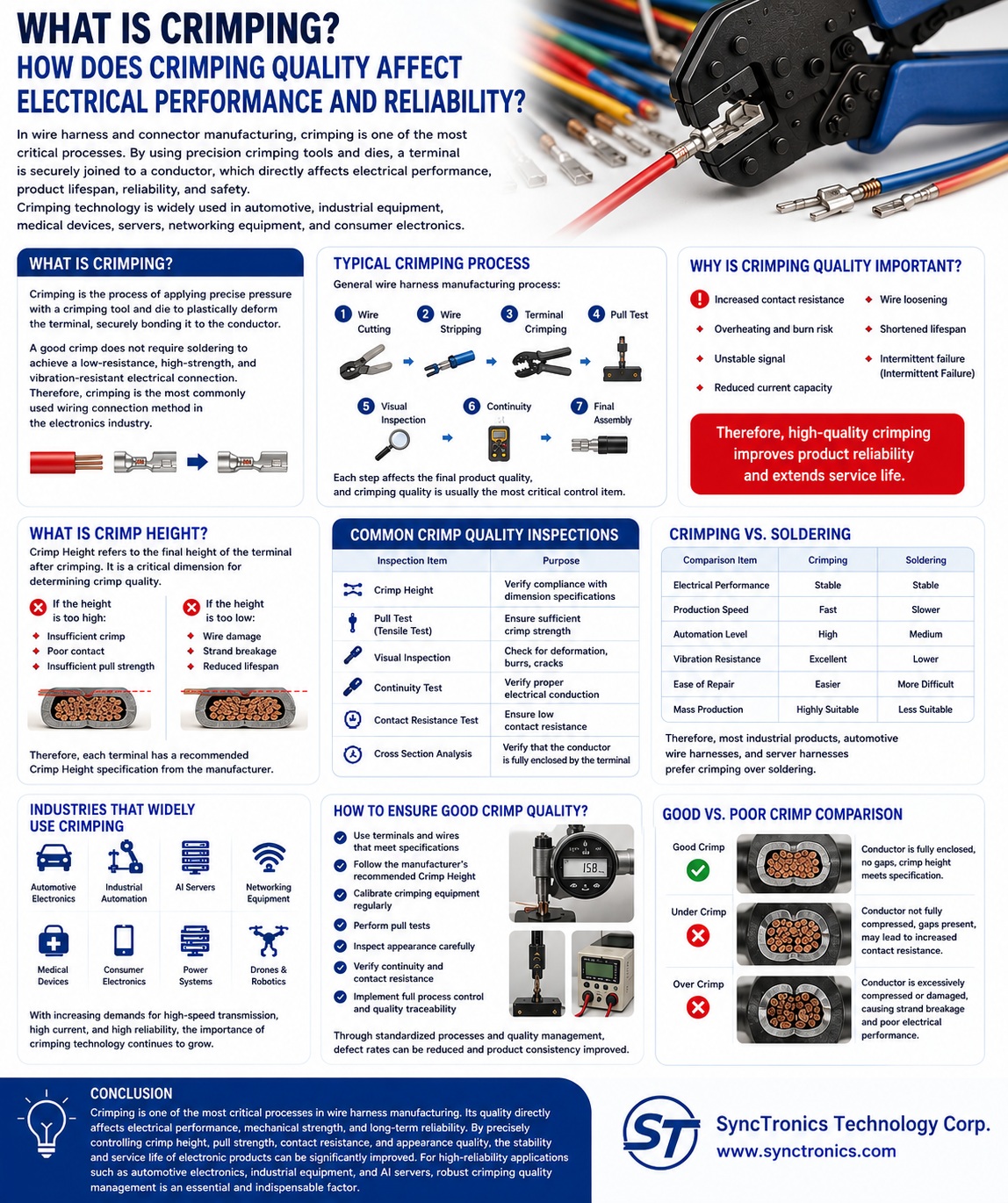
Crimping is one of the most critical manufacturing processes in wire harness and connector production. By using a dedicated crimping tool or die, a terminal is mechanically compressed onto a conductor to create a secure electrical and mechanical connection.
The quality of a crimp directly affects electrical conductivity, mechanical strength, product reliability, and long-term service life. Today, crimping is widely used in automotive electronics, industrial automation, AI servers, networking equipment, medical devices, and consumer electronics.
What Is Crimping?
Crimping is a cold-forming process that permanently joins a terminal to a conductor by applying controlled pressure. The metal deforms plastically, creating a gas-tight electrical connection without the need for solder.
Because of its low electrical resistance, excellent vibration resistance, and suitability for automated production, crimping has become the preferred connection method in modern electronics manufacturing.
Typical Crimping Process
A standard wire harness manufacturing process generally includes:
- Wire cutting
- Wire stripping
- Terminal crimping
- Pull testing
- Visual inspection
- Continuity testing
- Final assembly
Among these steps, terminal crimping is considered one of the most important factors affecting overall product quality.
Why Is Crimp Quality So Important?
Poor crimp quality may result in:
- Increased contact resistance
- Excessive heat generation
- Unstable signal transmission
- Reduced current-carrying capability
- Loose terminals
- Shortened product lifespan
- Intermittent electrical failures
A properly executed crimp significantly improves both electrical performance and long-term reliability.
What Is Crimp Height?
Crimp Height refers to the final compressed height of a crimped terminal. It is one of the most important quality control measurements during production.
If the Crimp Height is too high:
- Under-crimping may occur
- Poor electrical contact
- Insufficient pull strength
If the Crimp Height is too low:
- Wire strands may be damaged
- Conductor breakage may occur
- Product reliability decreases
Each terminal manufacturer specifies an acceptable Crimp Height range to ensure optimal performance.
Common Crimp Quality Inspections
|
Inspection Item |
Purpose |
|
Crimp Height |
Verify dimensional accuracy |
|
Pull Test |
Confirm mechanical strength |
|
Visual Inspection |
Detect deformation, cracks, or defects |
|
Continuity Test |
Verify electrical continuity |
|
Contact Resistance Test |
Measure electrical resistance |
|
Cross-Section Analysis |
Evaluate conductor compression quality |
Crimping vs. Soldering
|
Comparison |
Crimping |
Soldering |
|
Electrical Performance |
Excellent |
Excellent |
|
Production Speed |
Fast |
Slower |
|
Automation |
Highly suitable |
Moderate |
|
Vibration Resistance |
Excellent |
Lower |
|
Maintenance |
Easier |
More difficult |
|
Mass Production |
Ideal |
Less efficient |
For these reasons, crimping is widely preferred in automotive wiring harnesses, industrial equipment, AI servers, and high-volume electronic manufacturing.
Industries That Commonly Use Crimping
Crimping technology is extensively applied in:
- Automotive electronics
- Industrial automation
- AI servers
- Networking and telecommunications
- Medical equipment
- Consumer electronics
- Power systems
- Robotics and drones
As demand grows for high-speed data transmission, high-current applications, and reliable electrical connections, the importance of precision crimping continues to increase.
How to Evaluate Crimp Quality
A high-quality crimp should include:
- Proper terminal and wire selection
- Correct Crimp Height
- Regular calibration of crimping equipment
- Pull strength verification
- Thorough visual inspection
- Continuity and contact resistance testing
- Complete process control and material traceability
Implementing standardized manufacturing procedures helps reduce defects while improving consistency and product reliability.
Conclusion
Crimping is one of the most important processes in wire harness manufacturing. Proper crimp quality directly influences electrical conductivity, mechanical durability, and long-term product reliability. By controlling Crimp Height, pull strength, contact resistance, and inspection procedures, manufacturers can significantly improve product performance and reduce failure rates. For industries requiring high reliability—including automotive electronics, industrial automation, and AI server infrastructure—effective crimp quality management is essential.
Need Wire Harnesses, Connectors,
Electromechanical Components, or Custom Solutions? Contact Us Today
Whether you are looking for connectors,
cables, wire harness assemblies, electromechanical components, or complete
electronic interconnect solutions, SyncTronics provides professional technical
support and engineering evaluation for product selection, specification
verification, New Product Introduction (NPI), OEM/ODM customization, as well as
high-speed transmission, high-reliability, and other specialized application
requirements.
We welcome you to visit our Contact Us page
and share your project requirements and contact information. Our team is
committed to responding quickly and professionally, evaluating the most
suitable products and electronic interconnect solutions based on your product
specifications, application requirements, and project objectives. We also
provide technical recommendations and customized engineering support to help
shorten product selection and development time, reduce project risks, and
accelerate your path to mass production. We look forward to the opportunity to
work with you and provide reliable technical support and practical solutions
for every stage of your project.
Related Articles
What Is a Connector? Types and Applications Explained | SyncTronics Technology
What Is Connector Pitch? Complete Guide | SyncTronics Technology
Wire Cutting, Stripping, Crimping & Assembly Guide | SyncTronics Technology
What Is Metal Surface Treatment? Complete Guide | SyncTronics Technology
Disclaimer and Technical Exchange Statement
This content is compiled based on publicly available information and industry experience, intended solely for reference during technical exchanges. It does not constitute any commercial, technical, or legal advice or basis.
The specifications, materials, manufacturing processes, application methods, and related information described herein may vary due to differing design conditions, environmental factors, or usage scenarios. No guarantees are made regarding the completeness, correctness, or suitability of such content.
Readers should verify the suitability with the responsible design or technical personnel based on actual application scenarios, and independently assess all associated risks.
Frequently Asked Questions (FAQ)
- What is Connector Knowledge
- Wire Related issues
- Materials-Related
- Regulatory Issues
- Electronic issues
- Manufacturing Technology
- PM, RD, ME, PE, and QE in Electronics
- What Is NPI?
- What Is Injection Molding? Connector Housing Process and Quality Explained
- Drone Wire Harness Processing: Crimping, Vibration & Flex Design
- What Is Heat Shrink Tubing?
- What Is Crimping? How Crimp Quality Affects Electrical Performance and Reliability
- Crimping vs. Soldering: What's the Difference and Which Is Better?
- What Is SMT (Surface Mount Technology)? How Has It Transformed Electronics Manufacturing?
- What Is Automation in Wire Harness Processing? Benefits and Manufacturing Overview
- What Is Crimp Height? Why Is It Important in Terminal Crimping?
- What Is Wire Harness Assembly? A Complete Guide to the Wire Harness Manufacturing Process
- SMT vs. Through-Hole (DIP): What's the Difference and When Should Each Be Used?
- Testing & Verification
- Quality Management
- History & Evolution