
What Is EU Machinery Regulation 2023/1230? Automation Equipment & Electrical Safety Requirements Explained
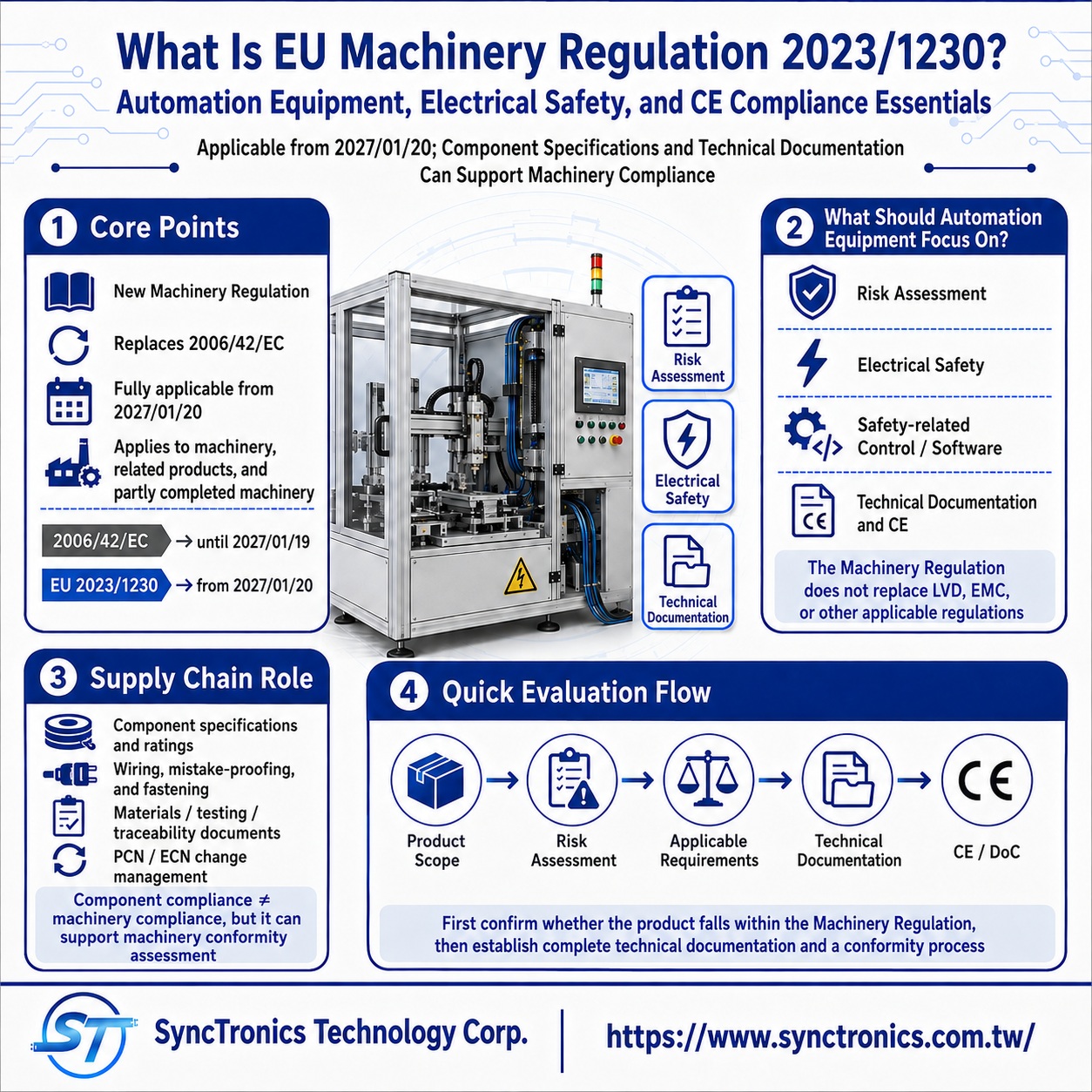
EU Regulation 2023/1230 is the European Union’s new Machinery Regulation, covering machinery, related products, and partly completed machinery. It is not a cable- or connector-specific regulation, and ordinary electrical components do not automatically require separate certification under the Machinery Regulation.
The regulation is still less familiar to many electronics companies because the current Machinery Directive 2006/42/EC remains applicable until January 19, 2027. Regulation (EU) 2023/1230 will become fully applicable on January 20, 2027, making 2026 an important transition period for machinery and automation suppliers.
For connector, cable, and wire harness suppliers, the key point is that these components can affect electrical safety, wiring reliability, incorrect connection prevention, mechanical protection, and system-level risk assessment once they are integrated into machinery.
What Products Does EU 2023/1230 Cover?
The regulation applies to several categories of machinery-related products.
|
Product Type |
General Scope |
|
Machinery |
Complete machinery and equipment |
|
Interchangeable Equipment |
Equipment that changes or adds a machine function |
|
Safety Components |
Components performing safety-related functions |
|
Lifting Accessories |
Products used for lifting operations |
|
Certain Transmission Components |
Specific mechanical transmission products |
|
Partly Completed Machinery |
Machinery requiring further integration before performing a specific function |
Industrial automation systems, production equipment, material-handling systems, and other machinery may therefore need to be evaluated against the regulation depending on their intended use.
How Is It Different from the Machinery Directive?
One major change is the transition from a Directive to a directly applicable Regulation.
The new framework also places greater emphasis on areas such as:
- Safety-related software and control systems
- Certain autonomous or AI-related safety functions
- Cybersecurity risks that could affect safety functions
- Digital instructions and compliance documentation
- Responsibilities related to substantial modifications
The regulation therefore reflects modern machinery that increasingly combines mechanical systems, electronics, software, networking, and automated control.
Are Electrical Components Directly Regulated by EU 2023/1230?
Not necessarily.
A connector, cable, terminal, or wire harness does not automatically become a Machinery Regulation product simply because it is installed inside a machine.
However, machinery manufacturers must control electrical hazards and ensure that the complete equipment is safe.
This means component specifications may still be important for:
- Rated voltage and current
- Wire and connector suitability
- Pinout and incorrect-mating prevention
- Insulation and protective bonding
- Harness fixation and mechanical protection
- Material and technical documentation
The important distinction is:
Component compliance does not equal machinery compliance, but correct component selection and documentation can support system-level compliance.
How Do CE, LVD, and EMC Fit Together?
EU 2023/1230 does not replace every other EU product regulation.
Depending on the equipment, manufacturers may also need to consider:
|
Requirement |
Main Focus |
|
Machinery Regulation |
Overall machinery safety |
|
LVD |
Electrical safety within applicable voltage ranges |
|
EMC |
Electromagnetic compatibility |
|
RoHS |
Restricted hazardous substances |
|
REACH |
Chemical substances and supply chain information |
CE marking therefore does not mean that only one regulation has been addressed.
The manufacturer must first determine which EU requirements apply to the actual product, then establish the required technical documentation and conformity assessment.
What Should Automation Equipment Suppliers Prepare?
For machinery manufacturers, a typical compliance process may include:
Product Scope → Risk Assessment → Applicable Requirements → Technical Documentation → Conformity Assessment → EU Declaration → CE Marking
For component and interconnect suppliers, the more practical responsibility is to provide accurate, traceable information linked to the correct part number, such as:
- Datasheets
- Electrical and environmental ratings
- Material compliance documents
- Relevant test or quality information
- Part number and revision data
- PCN / ECN change information
These records help machinery manufacturers manage system-level risk and technical documentation.
Summary
EU Regulation 2023/1230 is the next-generation EU machinery safety framework and will fully replace Machinery Directive 2006/42/EC on January 20, 2027.
For automation equipment, the regulation addresses overall machinery safety, risk assessment, electrical hazards, control systems, safety functions, technical documentation, and CE compliance.
For connector, cable, and wire harness suppliers, the main requirement is generally not to obtain a separate “Machinery Regulation certification,” but to ensure that component specifications, electrical ratings, wiring information, materials, and documentation can support the safety and conformity assessment of the complete machine.
SyncTronics Solutions
SyncTronics Technology can support industrial automation, machinery, and electronic interconnect projects by assisting with connector, wire, terminal, and wire harness specification review, including electrical ratings, material requirements, environmental conditions, and related supplier documentation.
For NPI, OEM/ODM, and supply chain integration projects, SyncTronics can also support part-number verification, alternative part evaluation, material compliance documentation, and change-information management. Final applicability of EU Regulation 2023/1230, CE marking, and other EU legal requirements should always be determined by the final equipment manufacturer based on the product function, risk assessment, and target market.
Need Wire Harnesses, Connectors, Electromechanical Components, or Custom Solutions? Contact Us Today
Whether you are looking for connectors, cables, wire harness assemblies, electromechanical components, or complete electronic interconnect solutions, SyncTronics provides professional technical support and engineering evaluation for product selection, specification verification, New Product Introduction (NPI), OEM/ODM customization, as well as high-speed transmission, high-reliability, and other specialized application requirements.
We welcome you to visit our Contact Us page and share your project requirements and contact information. Our team is committed to responding quickly and professionally, evaluating the most suitable products and electronic interconnect solutions based on your product specifications, application requirements, and project objectives. We also provide technical recommendations and customized engineering support to help shorten product selection and development time, reduce project risks, and accelerate your path to mass production. We look forward to the opportunity to work with you and provide reliable technical support and practical solutions for every stage of your project.
Related Articles
What Is LVD? Low Voltage Directive Explained | SyncTronics Technology
What Is EMC? Electromagnetic Compatibility Explained | SyncTronics Technology
CE Marking Guide: Essential Requirements for Europe | SyncTronics
Disclaimer and Technical Exchange Statement
This content is compiled based on publicly available information and industry experience, intended solely for reference during technical exchanges. It does not constitute any commercial, technical, or legal advice or basis.
The specifications, materials, manufacturing processes, application methods, and related information described herein may vary due to differing design conditions, environmental factors, or usage scenarios. No guarantees are made regarding the completeness, correctness, or suitability of such content.
Readers should verify the suitability with the responsible design or technical personnel based on actual application scenarios, and independently assess all associated risks.
Frequently Asked Questions (FAQ)
- What is Connector Knowledge
- Wire Related issues
- Materials-Related
- Regulatory Issues
- What Is EU Machinery Regulation 2023/1230? Automation Equipment & Electrical Safety Requirements Explained
- What EU Cable Regulations Apply? RoHS, REACH, CPR & Material Compliance Explained
- What Is FCC Certification? A Complete Guide to U.S. Electronic Product Compliance
- What Is UL94? A Complete Guide to Flammability Ratings and Plastic Fire Resistance Standards
- What Are Conflict Minerals?
- What Is IP Rating?
- What Is UL Certification?
- What Is UL Fire Rating?
- What Is the LVD Directive?
- What Is EMC?
- What Is RoHS 2.0?
- What Is the RED Directive?
- What Are RoHS, REACH, and WEEE? Key Differences Explained
- What Is the REACH Regulation? A Complete Guide to EU Chemical Compliance
- What Is the WEEE Directive? What Are the Regulations for Electronic Waste Recycling?
- What Are CMRT and EMRT?
- What Is Halogen Free (HF)?
- What Is California Proposition 65?
- What Is CE Certification? The Key Compliance Requirement for Electronic Products Entering the European Market
- Electronic issues
- Manufacturing Technology
- Testing & Verification
- Quality Management
- History & Evolution