
What Is AQL (Acceptable Quality Level)?
What Is AQL (Acceptable Quality Level)? A Complete Guide to Sampling Inspection
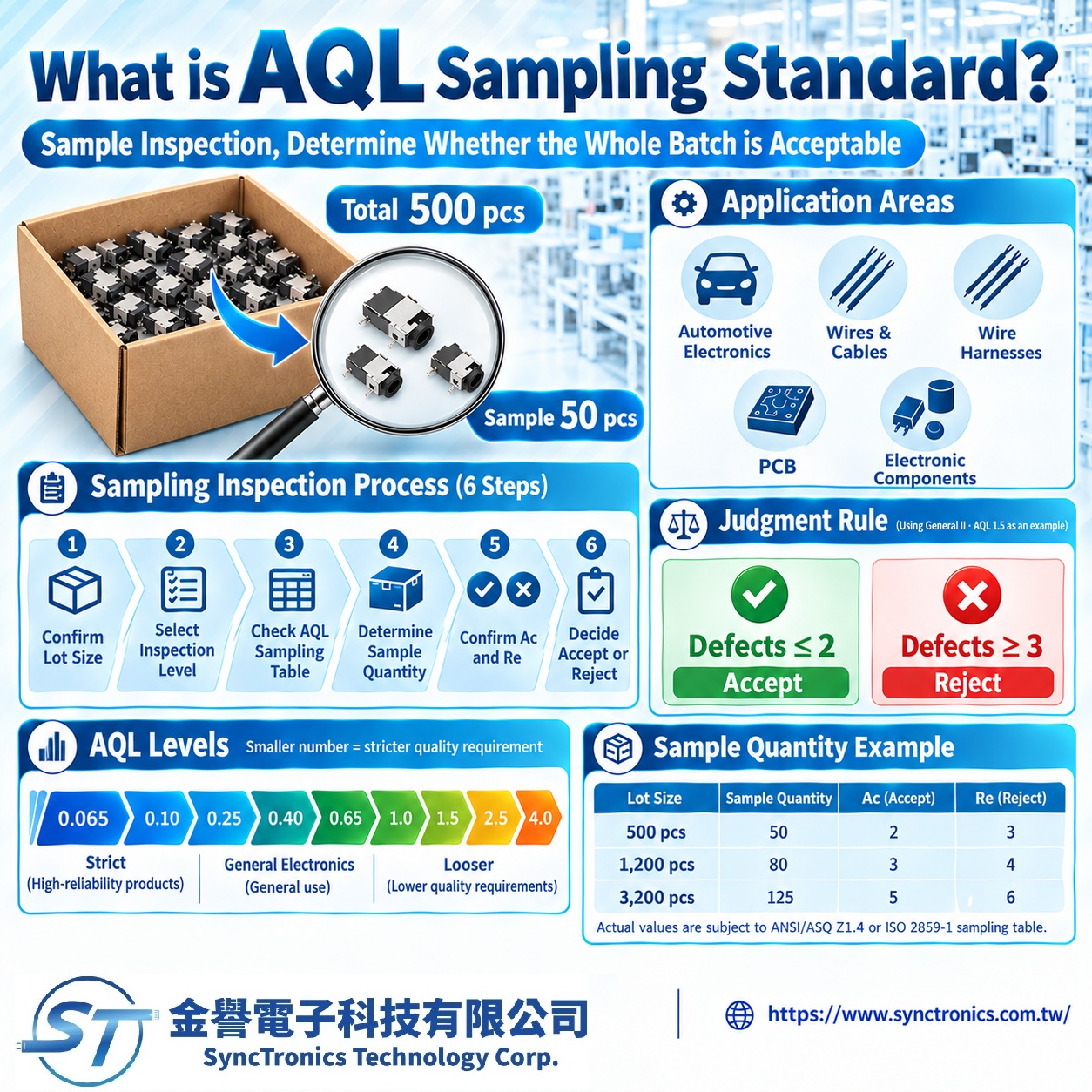
AQL (Acceptable Quality Level) is an internationally recognized sampling inspection standard used to determine whether a production lot meets predefined quality requirements without inspecting every individual product.
Instead of performing 100% inspection, AQL applies statistical sampling methods to balance product quality, inspection efficiency, and inspection costs. It is widely used across the electronics, automotive, industrial equipment, telecommunications, and medical device industries.
Why Is AQL Important?
Inspecting every product can significantly increase inspection time, labor costs, and production expenses.
By implementing AQL sampling, manufacturers can:
- Reduce inspection costs
- Improve inspection efficiency
- Maintain consistent product quality
- Evaluate production lots quickly
- Standardize quality control procedures
For these reasons, AQL has become one of the most widely adopted quality inspection methods worldwide.
How Does AQL Work?
A common misconception is that AQL allows a certain percentage of defective products. In reality, AQL is a statistical acceptance method used to determine whether an entire production lot should be accepted or rejected.
The typical process includes:
- Determine the lot size.
- Select the inspection level.
- Refer to the AQL sampling table.
- Determine the required sample size.
- Identify the Acceptance Number (Ac) and Rejection Number (Re).
- Decide whether to accept or reject the lot.
Common AQL Levels
Different products require different quality levels depending on customer requirements.
|
AQL Value |
Typical Application |
|
0.065 |
Extremely high-quality products |
|
0.10 |
High-reliability applications |
|
0.25 |
Precision electronic products |
|
0.40 |
Industrial equipment |
|
0.65 |
General electronic products |
|
1.0 |
Standard manufacturing |
|
1.5 |
General industrial applications |
|
2.5 |
Consumer products |
|
4.0 |
Products with lower quality requirements |
The appropriate AQL value is typically agreed upon by both customers and suppliers.
What Is an AQL Table?
An AQL Table is a statistical sampling chart used to determine:
- Sample Size
- Acceptance Number (Ac)
- Rejection Number (Re)
For example:
|
Lot Size |
Sample Size |
Ac |
Re |
|
500 pcs |
50 |
2 |
3 |
|
1,200 pcs |
80 |
3 |
4 |
|
3,200 pcs |
125 |
5 |
6 |
Actual sampling values are determined according to standards such as ANSI/ASQ Z1.4 or ISO 2859-1.
Common Inspection Levels
AQL sampling commonly uses the following inspection levels:
|
Inspection Level |
Typical Application |
|
General Level I |
Reduced inspection |
|
General Level II |
Most commonly used |
|
General Level III |
More stringent inspection |
|
Special Levels S1–S4 |
Special inspection requirements |
Among these, General Inspection Level II is the most frequently used in electronic manufacturing.
What Is the Difference Between AQL Sampling and 100% Inspection?
|
Item |
AQL Sampling |
100% Inspection |
|
Inspection Method |
Statistical sampling |
Every product inspected |
|
Inspection Cost |
Lower |
Higher |
|
Inspection Efficiency |
Higher |
Lower |
|
Typical Application |
Mass production |
Critical or high-risk products |
Manufacturers select the appropriate inspection method based on product risk and customer requirements.
Which Products Commonly Use AQL?
AQL sampling is widely applied to:
- Connectors
- Cables
- Wire harnesses
- Printed circuit boards (PCBs)
- Electronic components
- Automotive electronics
- AI servers
- Telecommunications equipment
- Industrial control systems
Many global OEMs and ODM manufacturers use AQL as a standard acceptance method.
How Is AQL Related to IQC, IPQC, and OQC?
AQL sampling is commonly used throughout manufacturing, including:
- Incoming Quality Control (IQC)
- In-Process Quality Control (IPQC)
- Outgoing Quality Control (OQC)
As a result, AQL is considered one of the most important sampling methods within modern quality management systems.
Conclusion
AQL (Acceptable Quality Level) is an internationally recognized statistical sampling standard that enables manufacturers to evaluate product quality efficiently while balancing inspection costs and production efficiency. By selecting appropriate sampling plans, inspection levels, and acceptance criteria, companies can improve quality management, strengthen supply chain reliability, and ensure consistent product quality.
SyncTronics Solutions
SyncTronics Technology provides connector and cable application solutions that support high-mix, low-volume production as well as diverse application requirements. Based on customer application requirements, we assist in evaluating suitable connectors, cables, and product specifications while providing recommendations regarding product quality requirements, material consistency, and reliability considerations. Our solutions help improve quality management and supply stability for industrial equipment, telecommunications systems, AI servers, and a wide range of electronic applications.
Need Wire Harnesses, Connectors, Electromechanical Components, or Custom Solutions? Contact Us Today
Whether you are looking for connectors,
cables, wire harness assemblies, electromechanical components, or complete
electronic interconnect solutions, SyncTronics provides professional technical
support and engineering evaluation for product selection, specification
verification, New Product Introduction (NPI), OEM/ODM customization, as well as
high-speed transmission, high-reliability, and other specialized application
requirements.
We welcome you to visit our Contact Us page
and share your project requirements and contact information. Our team is
committed to responding quickly and professionally, evaluating the most
suitable products and electronic interconnect solutions based on your product
specifications, application requirements, and project objectives. We also
provide technical recommendations and customized engineering support to help
shorten product selection and development time, reduce project risks, and
accelerate your path to mass production. We look forward to the opportunity to
work with you and provide reliable technical support and practical solutions
for every stage of your project.
Related Articles:
What Are Cp and Cpk? A Complete Guide to Process Capability Indices | SyncTronics Technology
What Is PPAP? A Complete Guide to the Production Part Approval Process | SyncTronics Technology
Disclaimer and Technical Exchange Statement
This content is compiled based on publicly available information and industry
experience, intended solely for reference during technical exchanges. It does
not constitute any commercial, technical, or legal advice or basis.
The specifications, materials, manufacturing processes, application methods,
and related information described herein may vary due to differing design
conditions, environmental factors, or usage scenarios. No guarantees are made
regarding the completeness, correctness, or suitability of such content.
Readers should verify the suitability with the responsible design or technical
personnel based on actual application scenarios, and independently assess all
associated risks.
Frequently Asked Questions (FAQ)
- What is Connector Knowledge
- Wire Related issues
- Materials-Related
- Regulatory Issues
- Electronic issues
- Manufacturing Technology
- Testing & Verification
- Quality Management
- MOQ vs. MPQ vs. SPQ
- What Is NCNR?
- What Is an LOA (Letter of Authorization)?
- ECR vs. ECN: How the Engineering Change Process Works
- How Is Material Traceability Managed for Energy Storage Wire Harnesses? Lot, Wire & Terminal Control
- What Is PPAP? A Complete Guide to the Production Part Approval Process
- What Are EOL and PCN?
- What Is Incoming Quality Control (IQC)?
- What Is In-Process Quality Control (IPQC)?
- What Is Outgoing Quality Control (OQC)?
- What Is AQL (Acceptable Quality Level)?
- What Are CoC and CoA?
- What Is Material Traceability?
- What Is a Date Code (D/C)?
- What Are LOT Numbers and BIN Codes?
- What Is FMEA (Failure Mode and Effects Analysis)?
- What Is an 8D Report?
- What Is Six Sigma?
- What Are Cp and Cpk?
- What Is a Control Plan?
- What Is ISO 9001?
- What Is IATF 16949?
- History & Evolution