
What Is a Connector?
What Is a Connector?
A connector is an electronic component used for mechanical and electrical connection. Its primary function is to establish a detachable, repeatedly matable signal or power transmission path between different circuits, modules, or devices. Connectors allow engineers to complete assembly, repair, or replacement quickly without directly soldering wires to a circuit board, making them a fundamental component in electronic product design and manufacturing.
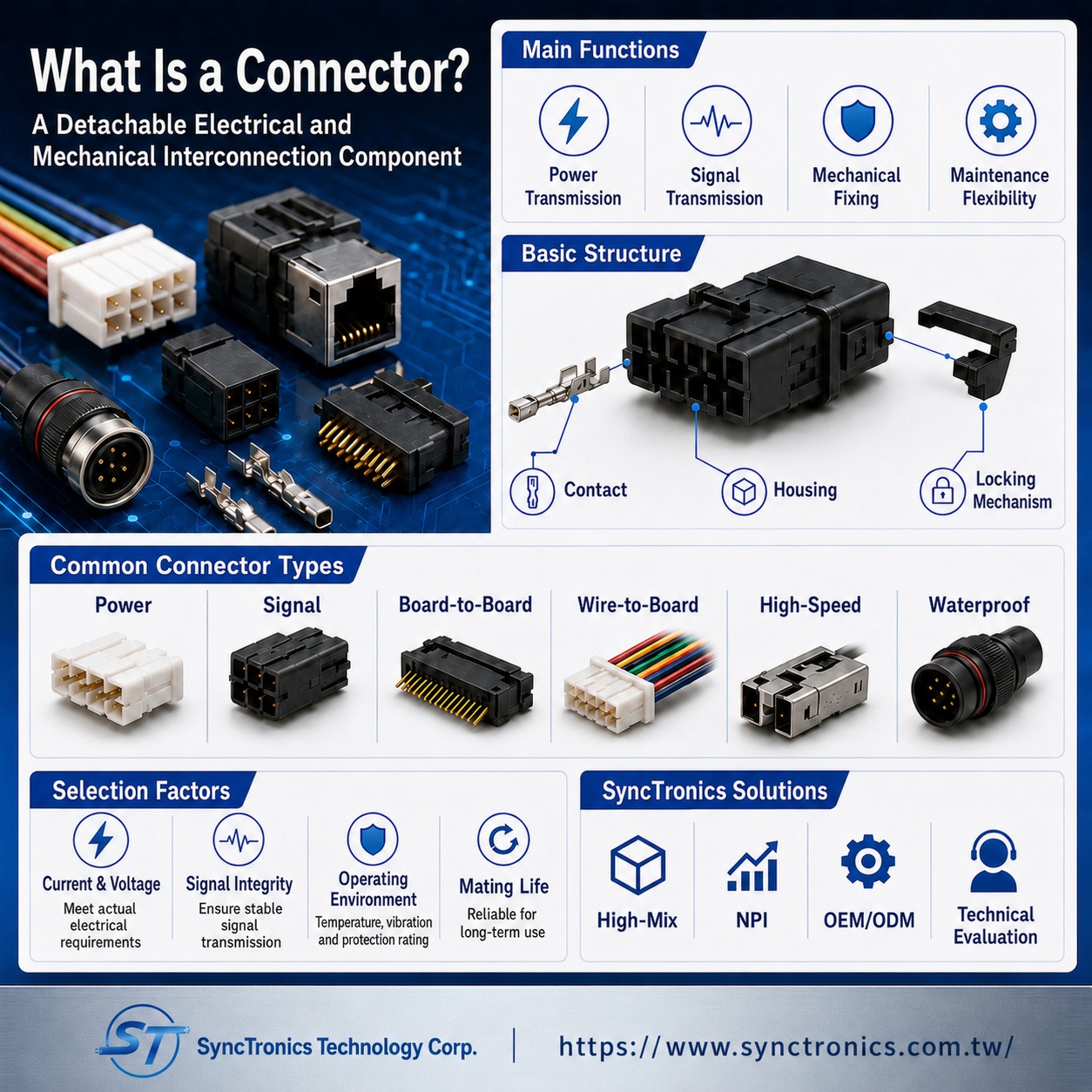
Key Functions of Connectors
Connectors serve multiple roles within an electronic system, including:
Power Transmission: Carrying power from the supply side to the load, ensuring stable equipment operation.
Signal Transmission: In data communication applications, connectors must offer good conductivity and shielding to prevent signal attenuation or interference.
Mechanical Fixation: Some connectors also provide structural support, ensuring cables or modules remain securely in place during use.
Maintenance and Expansion Flexibility: The detachable design provides greater flexibility during production, testing, and repair, helping to reduce overall costs.
Basic Structure of a Connector
A typical connector generally consists of the following components:
Contact: The metal component responsible for the actual conductive connection. Its material and plating directly affect conductivity and durability.
Housing: Provides fixation and insulation for the contacts and determines the connector's mating orientation and foolproof design.
Locking Mechanism: Ensures the connector remains securely mated and resistant to vibration or external force.
Common Types of Connectors
|
Type |
Key Characteristics |
Common Applications |
|
Power Connector |
Power transmission, higher current-carrying capacity |
Power supplies, battery modules |
|
Signal Connector |
Data signal transmission |
Communication equipment, sensors |
|
Board-to-Board Connector |
Direct connection between circuit boards |
Consumer electronics, server motherboards |
|
Wire-to-Board Connector |
Connection between cables and circuit boards |
Industrial equipment, home appliances |
|
High-Speed Connector |
Supports high-bandwidth data transmission |
Data centers, networking equipment |
|
Waterproof Connector |
Water and dust resistant rating |
Outdoor equipment, automotive electronics |
Key Considerations for Connector Selection
When selecting a connector, the following factors should be evaluated:
Current and Voltage Requirements: Select a connector specification suited to the current-carrying capacity and voltage rating required by the application.
Contact Resistance and Signal Integrity: High-frequency or high-speed applications require special attention to contact resistance and impedance matching to avoid affecting signal quality.
Operating Environment: Choose connectors with an appropriate protection rating based on the product's operating environment, such as high temperature, humidity, or vibration.
Mating Cycle Life: Evaluate the connector's rated number of mating cycles based on the product's usage frequency to ensure long-term reliability.
Why Connectors Matter
Although small in size, connectors are one of the key components affecting the overall reliability of an electronic system. Improper connector selection or design can lead to signal instability, poor contact, or even system failure. Understanding connector function and selection principles is therefore essential for engineers and procurement professionals during product development.
Technical Support from SyncTronics
SyncTronics supports High-Mix, Low-Volume electronic interconnect solutions, providing product selection, specification verification, and technical evaluation for a wide range of connectors based on customer product requirements. For power connectors, signal connectors, high-speed connectors, and other application scenarios, SyncTronics offers New Product Introduction (NPI) and OEM/ODM customization to help customers identify the most suitable connector solution based on actual circuit design and operating environment.
Need Wire Harnesses, Connectors, Electromechanical Components, or Custom Solutions? Contact Us Today
Whether you are looking for connectors, cables, wire harness assemblies, electromechanical components, or complete electronic interconnect solutions, SyncTronics provides professional technical support and engineering evaluation for product selection, specification verification, New Product Introduction (NPI), OEM/ODM customization, as well as high-speed transmission, high-reliability, and other specialized application requirements.
We welcome you to visit our Contact Us page and share your project requirements and contact information. Our team is committed to responding quickly and professionally, evaluating the most suitable products and electronic interconnect solutions based on your product specifications, application requirements, and project objectives. We also provide technical recommendations and customized engineering support to help shorten product selection and development time, reduce project risks, and accelerate your path to mass production. We look forward to the opportunity to work with you and provide reliable technical support and practical solutions for every stage of your project.
Related Articles
What Is Contact Resistance? Complete Guide | SyncTronics Technology
SMT vs DIP Connectors: Complete Comparison | SyncTronics Technology
What Is a Waterproof Cable? IP Ratings, Features & Applications | SyncTronics Technology
What Is the Relationship Between Electronics and Connecting Cables? | SyncTronics Technology
Disclaimer and Technical Exchange Statement
This content is compiled based on publicly available information and industry experience, intended solely for reference during technical exchanges. It does not constitute any commercial, technical, or legal advice or basis.
The specifications, materials, manufacturing processes, application methods, and related information described herein may vary due to differing design conditions, environmental factors, or usage scenarios. No guarantees are made regarding the completeness, correctness, or suitability of such content.
Readers should verify the suitability with the responsible design or technical personnel based on actual application scenarios, and independently assess all associated risks.
Frequently Asked Questions (FAQ)
- What is Connector Knowledge
- What Is a Connector?
- Euro-Style vs. Barrier Terminal Blocks
- Ring vs. Fork Terminals: Differences
- What Is an IDC Connector?
- Box Header vs. Ejector Header: Latching, Ejection, and When to Use Each
- What Is a Box Header?
- 6 Common Connector Selection Mistakes and How to Avoid Them
- How to Select a USB Type-C Connector: Mating Cycles, Current Rating & PCB Mounting
- How to Select Industrial Automation Connectors: Locking, Vibration Resistance & Retention
- How to Select Energy Storage Connectors: Current Rating, Contact Resistance & Keying
- Why Do High-Current Connectors Overheat? Contact Resistance, Terminals & Crimp Quality
- What Is a Terminal Block? Types, Structure & Selection
- Wire-to-Board vs. Board-to-Board Connectors: Structure and Selection
- How to Select Drone Connectors and Wire Harnesses: Power, Flight Controller, GPS and Signal Connections
- What Connectors Are Commonly Used in Drones? XT30, XT60, JST-GH, and DF13 Explained
- How to Select Drone Battery Connectors: XT30, XT60 and XT90
- Why Do Drone Connectors Become Loose? Vibration Resistance, Polarization and Retention Design
- RJ45 Connector Structure and Applications Guide
- What Is Connector Pitch?
- What Does Connector Pin Count Mean?
- What Is the Difference Between a Terminal, a Connector, and a Coupling?
- What Is Contact Resistance, and What Does It Affect?
- What Is Connector Insertion and Withdrawal Force?
- What Is Retention Force?
- What Is Poka-Yoke (Error-Proofing) Design?
- What Is Gold Plating Thickness? Why Does It Affect Connector Lifespan?
- What Is the Difference Between SMT Connectors and DIP Connectors?
- Wire Related issues
- Materials-Related
- Regulatory Issues
- Electronic issues
- Manufacturing Technology
- Testing & Verification
- Quality Management
- History & Evolution