
What Is Environmental Reliability Testing?
What Is Environmental Reliability Testing?
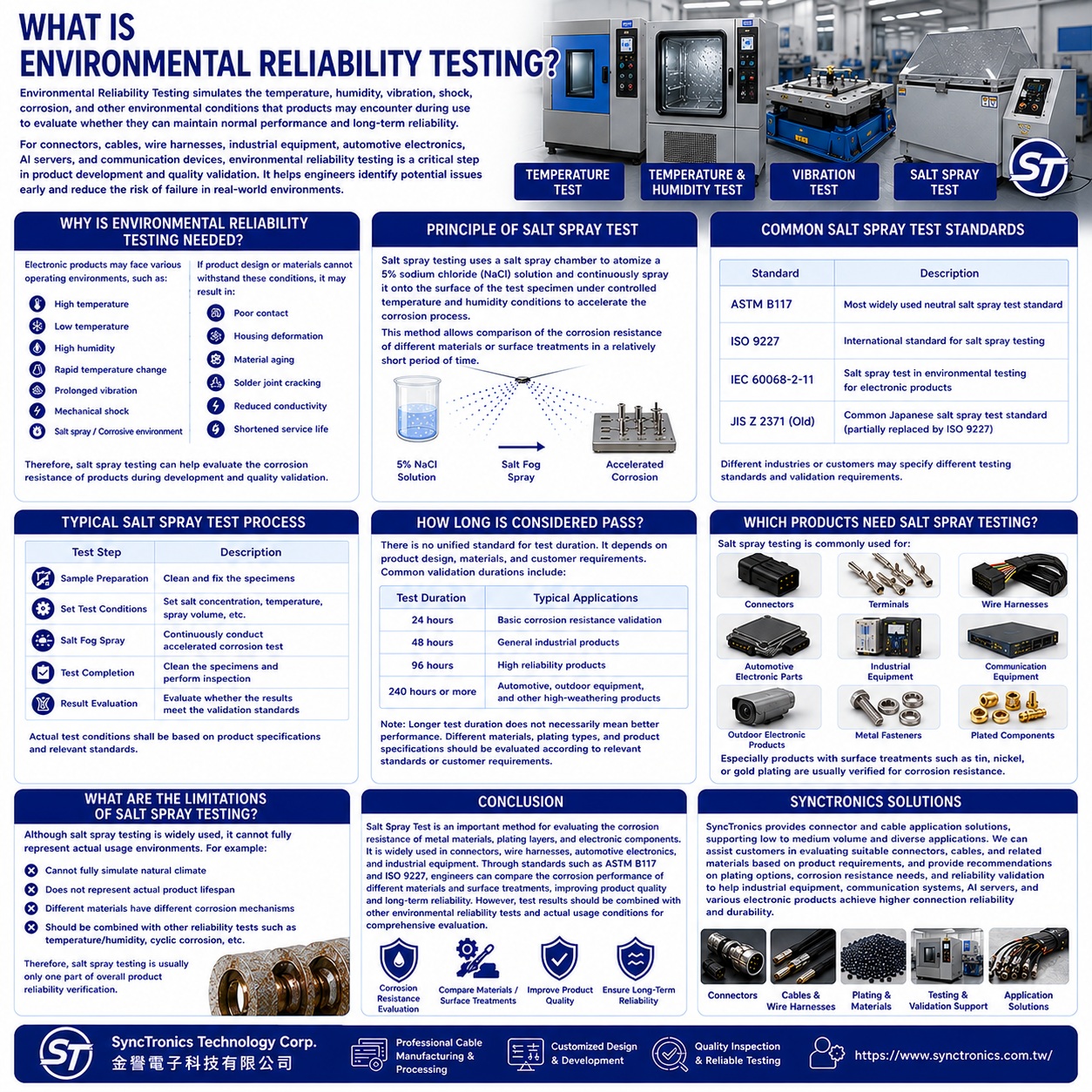
Environmental Reliability Testing is a series of verification procedures used to evaluate whether a product can maintain its intended performance and reliability when exposed to various environmental conditions such as temperature, humidity, vibration, mechanical shock, and corrosion.
For connectors, cables, wire harnesses, industrial equipment, automotive electronics, AI servers, and communication systems, Environmental Reliability Testing is an essential part of product development and quality validation. It helps engineers identify potential weaknesses before products are deployed in real-world operating environments.
Why Is Environmental Reliability Testing Important?
Electronic products may operate under a wide range of environmental conditions, including:
- High temperatures
- Low temperatures
- High humidity
- Rapid temperature changes
- Continuous vibration
- Mechanical shock
- Corrosive or salt-laden environments
Without proper design verification, these conditions may result in:
- Poor electrical contact
- Housing deformation
- Material degradation
- Solder joint cracking
- Reduced electrical performance
- Shortened product lifespan
Environmental Reliability Testing helps manufacturers evaluate product durability before mass production or field deployment.
Common Environmental Reliability Test Methods
|
Test Method |
Primary Purpose |
|
High Temperature Test |
Evaluates performance under elevated temperatures |
|
Low Temperature Test |
Verifies operation in cold environments |
|
Temperature & Humidity Test |
Assesses resistance to moisture and humidity |
|
Temperature Cycling Test |
Evaluates repeated thermal expansion and contraction |
|
Thermal Shock Test |
Simulates rapid temperature transitions |
|
Salt Spray Test |
Evaluates corrosion resistance |
|
Vibration Test |
Verifies durability under vibration conditions |
|
Mechanical Shock Test |
Evaluates resistance to sudden impacts |
The combination of test methods depends on product applications and customer requirements.
Common Testing Standards
Environmental Reliability Testing is commonly performed according to internationally recognized standards.
|
Standard |
Description |
|
IEC 60068 |
International environmental testing standard for electronic products |
|
MIL-STD-810 |
Military environmental engineering testing standard |
|
ASTM Standards |
Material and environmental testing standards |
|
ISO Standards |
International quality and environmental standards |
|
Customer Specifications |
Industry-specific or customer-defined qualification requirements |
The applicable standard depends on the target industry and product application.
Which Products Commonly Require Environmental Reliability Testing?
Environmental Reliability Testing is widely applied to:
- Connectors
- Cables and wire harnesses
- AI servers
- Networking equipment
- Industrial automation systems
- Automotive electronics
- Medical devices
- Consumer electronics
- Energy storage and power equipment
Products designed for continuous operation or harsh environments generally require comprehensive environmental qualification.
Benefits of Environmental Reliability Testing
Environmental Reliability Testing offers several important advantages:
- Identifies design weaknesses early
- Verifies long-term material durability
- Improves product reliability
- Reduces warranty and maintenance costs
- Increases customer confidence
- Supports product qualification requirements
For these reasons, reliability testing has become a standard part of modern electronic product development.
Does Environmental Reliability Testing Guarantee a Product Will Never Fail?
No.
Environmental Reliability Testing evaluates product performance under specific simulated conditions. While it helps engineers assess product robustness and reliability, it cannot reproduce every real-world operating environment or guarantee that a product will never experience failure.
Comprehensive product reliability requires a combination of environmental testing, design verification, manufacturing quality control, and application-specific evaluation.
Conclusion
Environmental Reliability Testing is a critical validation process for modern electronic products. By simulating conditions such as extreme temperatures, humidity, thermal shock, vibration, and corrosion, manufacturers can evaluate product durability, reduce failure risks, and improve long-term reliability. As AI computing, industrial automation, automotive electronics, and communication technologies continue to advance, Environmental Reliability Testing has become increasingly important for ensuring dependable product performance.
SyncTronics Solutions
SyncTronics Technology provides connector and cable application solutions that support high-mix, low-volume production as well as diverse application requirements. Based on customer application needs, we assist in evaluating suitable connectors, cables, and material specifications while providing recommendations related to environmental reliability, temperature resistance, humidity resistance, corrosion resistance, and product qualification requirements. Our solutions help improve long-term connection reliability and operational stability for industrial equipment, telecommunications systems, AI servers, and a wide range of electronic products.
Need Wire Harnesses, Connectors,
Electromechanical Components, or Custom Solutions? Contact Us Today
Whether you are looking for connectors,
cables, wire harness assemblies, electromechanical components, or complete
electronic interconnect solutions, SyncTronics provides professional technical
support and engineering evaluation for product selection, specification
verification, New Product Introduction (NPI), OEM/ODM customization, as well as
high-speed transmission, high-reliability, and other specialized application
requirements.
We welcome you to visit our Contact Us page
and share your project requirements and contact information. Our team is
committed to responding quickly and professionally, evaluating the most
suitable products and electronic interconnect solutions based on your product
specifications, application requirements, and project objectives. We also
provide technical recommendations and customized engineering support to help
shorten product selection and development time, reduce project risks, and
accelerate your path to mass production. We look forward to the opportunity to
work with you and provide reliable technical support and practical solutions
for every stage of your project.
Related Articles:
Gold Plating Thickness Explained | SyncTronics Technology
What Is Crosstalk? Causes, Effects, and Prevention Methods Explained | SyncTronics Technology
What Is Hi-Pot Testing? Dielectric Withstand Test Principles and Standards | SyncTronics Technology
Disclaimer and Technical Exchange
Statement
This content is compiled based on publicly available information and industry
experience, intended solely for reference during technical exchanges. It does
not constitute any commercial, technical, or legal advice or basis.
The specifications, materials, manufacturing processes, application methods,
and related information described herein may vary due to differing design
conditions, environmental factors, or usage scenarios. No guarantees are made
regarding the completeness, correctness, or suitability of such content.
Readers should verify the suitability with the responsible design or technical
personnel based on actual application scenarios, and independently assess all
associated risks.
Frequently Asked Questions (FAQ)
- What is Connector Knowledge
- Wire Related issues
- Materials-Related
- Regulatory Issues
- Electronic issues
- Manufacturing Technology
- Testing & Verification
- Bend Testing vs. Torsion Testing: Dynamic Cable Reliability Verification Explained
- What Tests Are Required for Battery Wire Harnesses? Continuity, Hi-Pot, Temperature Rise & Pull Testing
- What Is Vibration Testing? Principles, Test Conditions & Reliability Verification
- What Tests Do Drone Connectors and Wire Harnesses Need?
- What Is Contact Resistance Testing? Measurement Principles, Standards, and Importance Explained
- What Is Environmental Reliability Testing?
- What Is the Salt Spray Test? Corrosion Resistance Testing Principles, Standards, and Applications
- What Is Characteristic Impedance? Why Do High-Speed Cables Require Impedance Measurement?
- What Is Current Carrying Capacity (Ampacity)? How Is a Cable's Safe Current Rating Determined?
- What Is Fluke Network Cable Testing? Fluke Test Standards & Certification Guide
- What Is Connector Mating Cycle Testing?
- What Is a Pull Test?
- What Is Continuity Testing?
- What Is Hi-Pot Testing? Dielectric Withstand Test Principles, Standards, and Applications
- What Is an SGS Test Report? Testing Scope, Services, and Certification Differences Explained
- Quality Management
- History & Evolution